
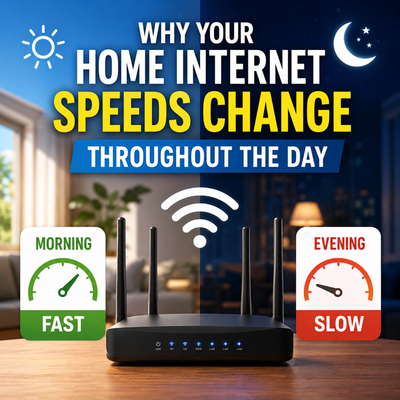
Why Your Home Internet Speeds Change Throughout the Day
Posted by Gordon Reed on 18th Jun 2026
Have you ever noticed that your internet seems incredibly fast in the morning but slows down significantly in the evening? Maybe your streaming service starts buffering, online gaming becomes laggy, or video calls lose quality during certain hours of the day. If so, you're not imagining things.
Internet speeds often fluctuate throughout the day, even when you're paying for the same service and using the same equipment. These changes are usually caused by a combination of network congestion, local Wi-Fi conditions, internet service provider infrastructure, and, in some cases, the type of internet connection you use.
Understanding why these speed changes occur can help you identify potential issues and improve your overall online experience.
Understanding Internet Speed Fluctuations:
When people talk about internet speed, they are typically referring to download and upload speeds. Download speed affects how quickly you can stream videos, browse websites, or download files. Upload speed impacts activities such as video conferencing, cloud backups, and sharing content online.
However, speed is only one part of internet performance. Latency, often measured as ping, also plays a significant role. High latency can make applications feel slow even when speed tests show strong results.
This is why you may occasionally see excellent speed test numbers while still experiencing buffering or delays. Real-world performance depends on many factors beyond raw bandwidth.
Peak Usage Hours: The Internet's Rush Hour:
One of the biggest reasons internet speeds change throughout the day is network congestion.
Just as roads become crowded during rush hour, internet networks experience periods of high demand. In many residential areas, internet usage peaks during the late afternoon and evening when people return home from work or school.
During these hours, users may be:
- Streaming movies and television
- Participating in video calls
- Playing online games
- Downloading software updates
- Using smart home devices
- Browsing social media
As demand increases, available bandwidth is shared among more users. This can result in slower speeds, higher latency, and reduced performance across various applications.
How Different Internet Technologies Are Affected:
Not all internet services respond to congestion in the same way.
- Cable Internet
Cable internet often uses shared infrastructure within a neighborhood. If many subscribers are actively using the network simultaneously, available bandwidth may become strained, leading to slower speeds during peak periods.
- Fiber Internet
Fiber networks generally offer more capacity and are less susceptible to congestion. However, even fiber customers can experience slowdowns if upstream network resources become overloaded.
- Fixed Wireless Internet
Fixed wireless services rely on radio links between customer locations and nearby towers. Network congestion and environmental conditions can affect performance, particularly during high-demand periods.
- LTE and 5G Home Internet
Cellular home internet services continue to grow in popularity, but they can experience noticeable speed variations throughout the day. Since LTE and 5G home internet users share tower resources with mobile devices, network demand can significantly impact performance during busy hours.
- Cellular Home Internet and Time-of-Day Performance
For users relying on LTE or 5G home internet, network congestion can have a particularly noticeable effect.
Cell towers have a finite amount of capacity. As more smartphones, tablets, hotspots, vehicles, and home internet users connect to the same tower, available resources must be distributed among all active devices.
This means your connection may perform differently depending on:
- Time of day
- Number of active users on the tower
- Carrier network management policies
- Local events that increase network usage
- Seasonal population changes
A common misconception is that a strong signal automatically guarantees fast speeds. While signal strength is important, network capacity often becomes the limiting factor during busy periods.
Even when your router displays a strong LTE or 5G signal, congestion can still reduce overall throughput.
Wi-Fi Conditions Inside Your Home:
Sometimes the issue isn't your internet service at all.
Your home's Wi-Fi environment can change throughout the day as more devices become active.
Modern households often contain dozens of connected devices, including:
- Smartphones
- Tablets
- Smart TVs
- Streaming devices
- Security cameras
- Smart speakers
- Gaming consoles
- Smart appliances
As these devices compete for wireless airtime, overall network performance can be affected.
Additionally, neighboring Wi-Fi networks can contribute to interference, particularly in apartments, condominiums, and densely populated neighborhoods. During evening hours, more nearby networks are active, increasing competition for available wireless channels.
Weather and Environmental Influences:
Certain internet technologies can also be affected by environmental conditions.
Heavy rain, snow, storms, and atmospheric changes may impact:
- Fixed wireless internet systems
- Satellite internet services
- Cellular networks
While modern wireless systems are designed to operate reliably in most weather conditions, severe weather events can still influence signal quality and network performance.
Environmental factors generally play a smaller role than congestion, but they can contribute to performance changes under certain circumstances.
How to Determine What's Causing Your Slow Speeds:
If you're experiencing inconsistent internet performance, a little troubleshooting can help identify the source of the problem.
Start by running speed tests at different times throughout the day. Compare results from the morning, afternoon, and evening over several days to identify patterns.
Next, test your connection using both Wi-Fi and a wired Ethernet connection. If wired performance remains consistent while Wi-Fi speeds fluctuate, the issue is likely within your local network rather than your internet provider.
For LTE and 5G internet users, reviewing signal metrics can also provide valuable insights. Measurements such as RSRP, RSRQ, and SINR can reveal whether signal quality is contributing to performance issues.
Improving Internet Performance Throughout the Day:
Although some factors are outside your control, there are several steps you can take to improve your internet experience.
- Optimize Router Placement
Place your router in a central location away from large metal objects, thick walls, and other sources of interference. Proper placement can significantly improve wireless coverage throughout your home.
- Keep Equipment Updated
Router manufacturers frequently release firmware updates that improve stability, performance, and security. Keeping equipment current can help maintain optimal performance.
- Reduce Wi-Fi Congestion
Selecting less crowded Wi-Fi channels and upgrading to newer Wi-Fi technologies can help reduce interference and improve network efficiency.
- Consider External Antennas for Cellular Internet
For LTE and 5G home internet users, external antennas can often improve signal quality and network stability.
A properly selected antenna can help:
- Improve signal strength
- Increase signal quality
- Enhance SINR performance
- Improve consistency during network fluctuations
- Provide more reliable connectivity in challenging locations
While an antenna cannot eliminate carrier congestion, it can help your router maintain a stronger and cleaner connection to the serving cell tower.
How AntennaGear Can Help:
At AntennaGear, we help customers improve connectivity for LTE and 5G home internet systems through carefully selected antenna solutions designed for a wide range of applications.
Whether you're using a cellular gateway, fixed wireless router, or 5G home internet device, choosing the right antenna can make a meaningful difference in overall performance and reliability.
Our team can help you identify antenna options based on your carrier, frequency bands, installation environment, and performance goals.
What This Means for You:
Changes in internet speed throughout the day are usually the result of network congestion, shared infrastructure, Wi-Fi interference, and varying demand across internet service provider networks. While some fluctuation is normal, understanding the factors behind these changes can help you improve performance and identify opportunities for optimization.
For LTE and 5G home internet users, signal quality plays a major role in maintaining reliable connectivity. Pairing your router or gateway with the right antenna solution can help create a stronger connection and improve consistency throughout the day.
For more information about antennas and connectivity solutions for home internet, visit AntennaGear.net.