
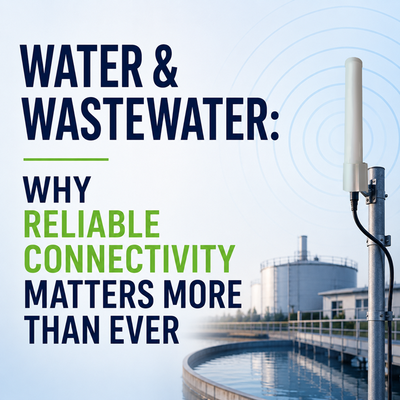
Water & Wastewater: Why Reliable Connectivity Matters More Than Ever
Posted by Gordon R. on 28th Aug 2026
Water and wastewater infrastructure has traditionally been associated with pumps, pipes, treatment systems, storage tanks, and mechanical controls. Increasingly, however, communications infrastructure is becoming just as important to keeping these systems visible and manageable.
Treatment facilities, lift stations, pumping stations, wells, reservoirs, storage tanks, and remote monitoring locations are becoming more connected. Operators can monitor equipment status, receive alarms, collect sensor data, and manage geographically dispersed assets without having personnel physically present at every location.
That connectivity creates an important dependency. When a communications link becomes unreliable, operators may lose visibility into equipment that could be miles away. In many locations, LTE and 5G cellular networks provide an effective way to establish that connection, especially where fiber, cable, or other wired services are unavailable or impractical.
But installing a cellular router does not automatically create a reliable connection. The RF environment, antenna system, coaxial cable, router configuration, cellular carrier, and network architecture all contribute to how well that connection performs.
Water and Wastewater Infrastructure Is Becoming More Connected
Modern water and wastewater systems can contain hundreds or even thousands of connected devices distributed across a large geographic area. Some equipment may be located inside a central treatment facility, while other assets may be miles away in relatively isolated locations.
SCADA systems are an important part of this infrastructure. Remote terminal units (RTUs), programmable logic controllers (PLCs), sensors, gateways, and industrial routers allow information to move between field equipment and centralized monitoring or control systems.
Connectivity may be used for applications including:
- Pump and lift station monitoring
- Tank, reservoir, and well monitoring
- Flow and pressure measurements
- Water-quality sensors
- Leak detection
- Chemical feed monitoring
- Equipment alarms
- Security cameras and access-control systems
For many of these applications, extremely high data rates are not necessarily the primary requirement. Reliability, consistency, latency, and the ability to maintain a connection over long periods can be much more important.
A remote sensor transmitting relatively small amounts of data may require very little bandwidth, but losing that connection for several hours can still create a significant operational problem.
Remote Infrastructure Creates Unique Connectivity Challenges:
One of the difficulties with water and wastewater communications is where the equipment is located.
A cellular router in an office building may have relatively favorable RF conditions. A router installed at a remote lift station can face an entirely different environment.
Equipment may be located below grade, inside concrete structures, behind terrain, surrounded by vegetation, or inside steel control cabinets. Treatment facilities can also contain large tanks, piping, machinery, electrical equipment, and other structures capable of affecting RF propagation.
The cellular network may technically provide coverage at the location while the router itself experiences marginal RF conditions.
This is why signal bars should not be the only measurement used when evaluating a cellular installation.
For LTE and 5G systems, measurements such as Reference Signal Received Power (RSRP), Reference Signal Received Quality (RSRQ), and Signal-to-Interference-plus-Noise Ratio (SINR) provide substantially more information about the RF environment.
RSRP primarily provides information about received reference signal power. RSRQ provides additional insight into signal quality and loading or interference conditions. SINR indicates how effectively the desired signal can be distinguished from interference and noise.
A connection can have relatively strong received signal power while still performing poorly because of interference or unfavorable signal quality. Conversely, a weaker signal operating in a relatively clean RF environment may perform better than expected.
The objective is not simply to obtain the strongest possible signal. It is to establish a stable RF link with sufficient signal quality for the application.
What Happens When Connectivity Becomes Unreliable?
When a cellular connection fails at a remote water or wastewater location, the equipment at the site does not necessarily stop operating.
A pump controller, PLC, or other local automation system may continue performing its programmed functions normally. The problem is that operators may temporarily lose visibility into what that equipment is doing.
Telemetry may stop updating. Alarm notifications can be delayed. Historical data may become incomplete. Remote access to equipment may become unavailable. Personnel may need to travel to the site simply to determine whether the problem involves the equipment or the communications system.
This is an important distinction.
Network downtime can become operational uncertainty.
As more monitoring and management functions move onto connected systems, communications reliability becomes increasingly important to maintaining visibility across the entire water or wastewater network.
Why Cellular Networks Work Well for Distributed Infrastructure:
Connecting every remote asset with fiber or another wired connection is not always practical.
A pumping station may be several miles from the nearest suitable wired service. A monitoring station may be located alongside a reservoir or in a rural area. Extending physical communications infrastructure to these locations can be expensive, complicated, or simply unavailable.
Cellular networks provide another option.
An industrial LTE or 5G router can establish a WAN connection anywhere compatible cellular service is available. Ethernet-connected controllers, sensors, cameras, and other equipment can then communicate through the router.
Modern industrial routers may also provide Wi-Fi, VPN support, remote management, dual SIMs, multiple cellular carriers, wired WAN connections, and automatic failover capabilities.
This flexibility makes cellular particularly useful for geographically distributed infrastructure.
However, the performance of that connection still begins with the RF link between the router and the cellular network.
The Antenna Can Be Just as Important as the Router:
When a cellular connection performs poorly, replacing the router is often one of the first solutions considered.
Sometimes the router is the problem. Frequently, however, the problem is somewhere in the RF path.
A sophisticated 5G router cannot take full advantage of the network if its antennas cannot establish an adequate RF link with the serving cell.
This is where external antennas become particularly important.
An external antenna allows the RF portion of the system to be positioned independently of the router. The router can remain safely installed inside an equipment enclosure while the antenna is placed where RF conditions are more favorable.
This could mean mounting the antenna outside a building, on top of an enclosure, higher on a structure, or away from equipment and obstructions.
The antenna does not create cellular signal. Instead, proper antenna selection and placement can improve the RF link between the modem and the cellular network.
That distinction is important when troubleshooting cellular systems.
Reliability Also Requires Redundancy:
A well-designed antenna system can improve the connection between a router and the cellular network, but RF performance is only one component of reliability.
An antenna cannot prevent a carrier outage.
This is where network redundancy becomes important.
Depending on the router and application, redundancy strategies can include:
- Dual-SIM configurations
- Multiple cellular carriers
- Cellular backup for fiber, cable, or another wired WAN
- Automatic WAN failover
- Multi-network routers
- Connection monitoring and automatic recovery
Carrier diversity can be particularly useful at remote infrastructure sites.
Two carriers may use different cell sites, frequencies, network architectures, and backhaul. A failure affecting one network may therefore have little or no effect on another.
This highlights an important distinction: RF reliability and network redundancy address different failure modes.
A strong cellular signal does not guarantee that the carrier's network will always be available. Likewise, having two carriers provides limited benefit if the antenna system cannot establish an adequate RF connection to either network.
Reliable communications require considering both.
Designing for Outdoor and Industrial Environments:
RF performance is only part of antenna selection for water and wastewater applications.
The physical environment must also be considered.
Outdoor antennas may experience rain, snow, ice, UV exposure, wind, humidity, and substantial temperature variations. Locations near treatment processes may introduce additional environmental considerations.
The complete installation matters as well. An outdoor-rated antenna does not make an installation weather resistant if connectors, adapters, cable entry points, or mounting hardware are not properly installed.
For permanent outdoor installations, the antenna housing, mounting method, coaxial cable, connectors, and cable entry into the enclosure should be evaluated as a complete system.
Antenna placement should also account for nearby metal structures, tanks, piping, walls, equipment, and other objects that may affect the radiation pattern.
A Practical Connectivity Checklist:
When evaluating a new or existing cellular installation at a water or wastewater location, consider the entire communications path rather than immediately replacing a single component.
- Identify which cellular carriers provide coverage at the site.
- Determine which LTE and 5G bands are available and supported by the router.
- Review RSRP, RSRQ, and SINR instead of relying only on signal bars.
- Determine whether a building, equipment enclosure, terrain, or other obstruction is affecting the RF path.
- Test potential external antenna locations before finalizing the installation.
- Select an antenna covering the cellular frequency ranges required by the modem and carriers.
- Determine whether an omnidirectional or directional radiation pattern is more appropriate.
- Match the antenna system to the router's 2x2 or 4x4 MIMO configuration.
- Keep coaxial cable runs as short and low-loss as practical.
- Minimize unnecessary RF adapters and connection points.
- Properly weatherproof outdoor RF connections and cable entry points.
- Consider carrier diversity or WAN failover when connection availability is particularly important.
Taking measurements before and after an antenna change is especially useful. Comparing RSRP, RSRQ, SINR, connection stability, latency, and throughput can provide a much clearer picture of whether an antenna change actually improved the RF link.
Think About the Entire RF System:
Troubleshooting cellular connectivity is easier when the installation is viewed as a system rather than a collection of individual components.
A simplified cellular communications path can be viewed as:
Cellular Network → RF Environment → Antenna → Coaxial Cable → Connectors → Router/Modem → Local Network → Connected Equipment
A problem anywhere along this path can affect performance.
An excellent antenna cannot compensate for every carrier-network problem. A high-performance router cannot compensate for severe coaxial cable loss. A high-gain antenna may not solve an interference problem. Adding a second carrier does not help if neither carrier has a usable RF path from the antenna location.
This is why cellular connectivity problems should be approached systematically.
Start with the available networks and RF environment. Evaluate the signal metrics. Look at antenna location and radiation pattern. Account for cable loss. Verify the router's antenna and MIMO requirements. Then consider redundancy at the network level.
That approach is far more effective than simply searching for an antenna with the highest gain number.
What This Means for You:
Water and wastewater infrastructure is becoming increasingly connected, and cellular networks make it possible to reach locations where traditional wired communications may be difficult or impractical.
The challenge is making those connections dependable.
For a remote well, lift station, pumping station, reservoir, storage tank, treatment facility, or monitoring site, reliable cellular connectivity depends on more than whether an LTE or 5G router can initially connect to the network.
The RF environment matters. Antenna placement matters. Frequency coverage matters. MIMO configuration matters. Coaxial cable loss matters. Carrier selection and network redundancy matter.
When these elements are considered together, LTE and 5G can provide a flexible communications platform for connecting geographically distributed water and wastewater infrastructure.
AntennaGear.net offers cellular, Wi-Fi, GPS/GNSS, MIMO, and combination antenna solutions for industrial routers, gateways, modems, and other connected equipment. When selecting an antenna for a remote or challenging installation, matching the antenna to the router, available cellular bands, installation environment, and RF conditions can make the difference between simply having a connection and having a connection you can depend on.