
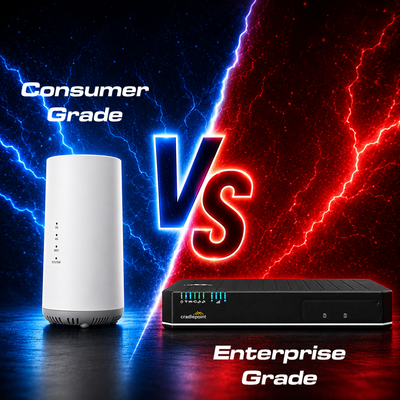
The Smart Alternative to Carrier-Issued Hotspots
Posted by Gordon Reed on 14th May 2026
For many people, the first step into cellular internet is a hotspot provided by their mobile carrier. These devices are easy to activate, simple to use, and often included with a data plan. For casual browsing, travel, or occasional backup internet use, they can work perfectly fine.
But over time, many users begin noticing limitations.
Maybe the connection slows down inside a vehicle. Maybe the hotspot overheats during long streaming sessions. Maybe signal strength appears strong, but speeds remain inconsistent. In some cases, the device simply lacks the networking features needed for remote work, business operations, security systems, or mobile connectivity setups.
This is where enterprise-grade cellular routers start to stand out.
Brands like Ericsson / Cradlepoint, Semtech / Sierra Wireless, Peplink, BEC, and Digi International build routers designed for demanding business and industrial applications. While these systems can be expensive when purchased new, the used market has made many of them surprisingly affordable.
In many real-world situations, a used enterprise router can dramatically outperform the consumer-grade hotspot sitting on a store shelf today.
What Makes an Enterprise Router Different?
Consumer hotspots are designed around simplicity and portability. Enterprise routers are designed around reliability, flexibility, and long-term performance.
That difference affects almost every part of the hardware design.
A typical carrier hotspot is usually intended for lighter-duty applications such as browsing the internet, checking email, or providing temporary travel connectivity. Enterprise routers, on the other hand, are commonly deployed in police vehicles, ambulances, utility fleets, branch offices, industrial facilities, transportation systems, and mobile command centers.
These are environments where network downtime can create serious problems, which means the hardware must be built to handle continuous operation under difficult conditions.
Because of this, enterprise routers often include advanced external antenna support, multiple Ethernet ports, VPN functionality, dual SIM support, advanced routing capabilities, ignition sensing for vehicles, ruggedized housings, and wide voltage input ranges. Many also support remote cloud management systems that allow organizations to monitor and troubleshoot devices from virtually anywhere.
In many ways, they function more like professional networking appliances than portable hotspots.
Better Antenna Support Can Completely Change Performance:
One of the biggest advantages enterprise routers offer is external antenna capability.
This is an area where many consumer hotspots struggle. Most carrier hotspots rely heavily on small internal antennas that are designed for compactness rather than maximum RF performance. While some consumer devices include external antenna ports, they are often far more limited than what enterprise-grade hardware supports.
Enterprise routers are usually designed from the beginning to work with external antennas. This allows users to install rooftop vehicle antennas, directional outdoor antennas, and high-performance MIMO systems that can dramatically improve signal quality and stability.
This becomes especially important in places where cellular coverage is inconsistent or difficult to penetrate. Rural environments, metal vehicles, industrial buildings, RV installations, and congested urban areas can all create challenging RF conditions.
Many users assume that signal bars tell the entire story, but they do not. A connection can show strong signal strength while still suffering from poor signal quality, interference, or heavy tower congestion.
An external antenna system connected to an enterprise router can often improve:
- SINR
- RSRQ
- upload consistency
- carrier aggregation performance
- overall connection stability
For some users, the jump from a carrier hotspot with internal antennas to an enterprise router with a properly installed MIMO antenna system feels like moving to an entirely different network.
Reliability Is Often More Important Than Maximum Speed:
Consumer hotspots are frequently marketed around peak theoretical throughput numbers. Enterprise routers are usually engineered around stability and uptime.
There is a major difference between briefly hitting extremely high download speeds in perfect conditions and maintaining a reliable connection all day long.
In real-world deployments, consistency is often far more valuable than short bursts of speed.
Many consumer hotspots are not designed for continuous operation inside hot vehicles, industrial cabinets, or harsh environments. Long operating sessions can sometimes lead to overheating, instability, or unexpected reboots.
Enterprise-grade hardware is typically built with continuous operation in mind. These systems often include better cooling systems, more robust power regulation, industrial-grade components, and wider operating temperature tolerances.
This is one reason why public safety organizations, fleets, utilities, and industrial operators frequently rely on enterprise cellular platforms instead of consumer hotspots.
A stable 80 Mbps connection that works all day is usually far more useful than a hotspot that occasionally reaches 500 Mbps but constantly fluctuates or requires reboots.
Enterprise Routers Give You More Control:
Another major difference between consumer hotspots and enterprise routers is the amount of control available to the user.
Carrier hotspots are intentionally simplified because carriers want devices that are easy to activate and difficult to misconfigure. Enterprise routers expose far more networking and cellular management options.
Depending on the platform, users may gain access to advanced features such as:
- band locking
- APN configuration
- carrier selection controls
- failover settings
- advanced routing
- VPN tunnels
- WAN prioritization
Many enterprise platforms also expose detailed modem diagnostics that can help users understand why a connection is underperforming.
This information may include:
- RSRP
- RSRQ
- SINR
- serving cell information
- carrier aggregation status
These tools can make troubleshooting significantly easier. Instead of simply seeing “good signal” on a hotspot screen, users can identify whether the modem is connected to a congested band, attaching to a distant tower, or experiencing interference problems.
For networking enthusiasts, mobile users, and businesses, this level of visibility can be incredibly valuable.
Enterprise Routers Are Built for Networking:
A consumer hotspot is primarily designed to share a cellular connection over Wi-Fi. An enterprise router is designed to manage an entire network.
That difference becomes more important as connectivity needs grow more complex.
Enterprise platforms commonly support advanced firewalling, VLANs, multi-WAN failover, site-to-site VPNs, QoS controls, remote device management, and segmented network configurations. These are features typically found in professional networking equipment rather than consumer hotspots.
Even home users can benefit from these capabilities. Remote workers, RV users, content creators, smart home enthusiasts, and small businesses often need far more than simple internet sharing.
In many situations, an enterprise router becomes the central backbone of an entire network infrastructure.
Buying Used Makes Enterprise Hardware Much More Affordable:
One of the biggest reasons enterprise routers are becoming more popular among consumers is the used market.
New enterprise hardware can be expensive, especially high-end LTE and 5G platforms. However, many businesses replace networking equipment on scheduled upgrade cycles even when the existing hardware still works perfectly well.
As a result, the used market is filled with enterprise-grade routers that remain extremely capable.
Many LTE Cat 18 and early 5G enterprise routers still perform exceptionally well today. In challenging RF environments, an older enterprise LTE router with excellent antenna support can sometimes outperform a newer consumer 5G hotspot with weak internal antennas and limited thermal management.
Used enterprise hardware often delivers:
- stronger build quality
- better RF performance
- advanced networking features
- longer expected operational life
- superior antenna integration
All while costing less than many premium consumer hotspots.
There Are a Few Tradeoffs:
Enterprise hardware is not perfect for everyone, and there are a few things worth considering before making the switch.
Some enterprise platforms use optional subscription services for cloud management and remote monitoring. Features tied to systems like NetCloud, Digi Remote Manager, or AirLink management platforms may require licensing. However, many routers still function perfectly well for local management without active subscriptions.
There is also a slightly steeper learning curve. Enterprise routers expose more settings and customization options, which can initially feel overwhelming for users unfamiliar with networking concepts. At the same time, that added flexibility is part of what makes these platforms so powerful.
Physical size can also be a consideration. Enterprise routers are commonly designed for fixed installations or vehicle mounting, so they are often larger and consume more power than compact battery-powered hotspots.
Which Enterprise Brands Are Popular?
Several enterprise networking brands have developed strong reputations in the cellular industry.
Ericsson / Cradlepoint platforms are widely used in fleets, transportation systems, branch networking, and public safety deployments. They are especially well known for strong cloud management ecosystems and reliable vehicle router platforms.
Semtech / Sierra Wireless routers have a strong reputation in industrial and mission-critical environments. Their AirLink platforms are frequently deployed in transportation, utility infrastructure, and industrial IoT applications where stability is critical.
Peplink has become extremely popular among RV users, mobile offices, content creators, and remote workers because of its strong multi-WAN and failover capabilities.
Meanwhile, Digi International is heavily focused on industrial IoT and remote infrastructure deployments, with rugged platforms commonly used in transportation, kiosks, and utility systems.
What This Means for You:
Carrier hotspots absolutely have their place. They are portable, convenient, and easy to use for light-duty connectivity needs.
But for users who need stronger signal performance, better antenna support, improved reliability, advanced networking capabilities, or more control over their cellular connection, a used enterprise-grade router can be an enormous upgrade.
In many cases, these systems deliver performance and stability that consumer hotspots simply were never designed to provide.
Whether you are building a mobile office, improving rural internet connectivity, outfitting a fleet vehicle, or simply trying to create a more reliable network, enterprise cellular hardware may be one of the smartest connectivity investments you can make.
For more information on antennas and connectivity solutions for enterprise cellular routers, visit AntennaGear.net.