
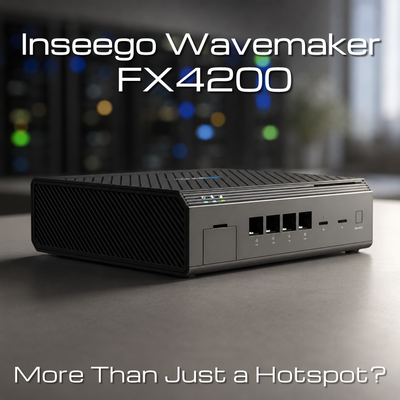
The Inseego FX4200. More Than Just a Hotspot?
Posted by Gordon Reed on 21st May 2026
Wireless internet has evolved far beyond simple mobile hotspots and portable MiFi devices. As 5G networks continue to expand, enterprise-grade cellular routers are becoming a practical solution for businesses, remote workers, industrial deployments, and even home users looking for an alternative to traditional wired internet services.
One device that has gained attention in this space is the Inseego Wavemaker FX4200. While it may resemble a standard home internet gateway at first glance, the FX4200 is built for much more demanding applications. It combines advanced 5G connectivity, enterprise networking features, Wi-Fi 7 support, and external antenna capabilities into a platform designed for reliability and long-term deployment.
Whether the goal is primary internet access, failover connectivity, or mobile networking, the FX4200 is designed to provide a level of flexibility and performance that most consumer hotspots simply cannot match.
What Is the Inseego Wavemaker FX4200?
The FX4200 is an indoor 5G cellular router designed for enterprise and professional networking environments. Unlike small portable hotspots that focus primarily on convenience and portability, the FX4200 is intended to serve as a serious networking appliance capable of supporting large numbers of connected devices and handling continuous operation.
It supports both 5G NR and LTE networks, allowing it to maintain compatibility across a wide range of carrier deployments. This is especially important because many areas still rely heavily on LTE infrastructure, even as carriers continue expanding their 5G coverage.
The router is commonly used for branch offices, remote work environments, temporary job sites, mobile command setups, fixed wireless internet access, and backup internet failover applications. In many cases, it serves as either a primary WAN connection or as a secondary backup connection designed to keep networks online during outages.
Understanding the FX4200’s 5G Performance:
Modern 5G networking is far more complicated than simply connecting to a tower and receiving signal bars. Real-world performance depends on many factors working together simultaneously.
The FX4200 supports advanced modem technologies such as carrier aggregation and 4x4 MIMO, both of which play major roles in maximizing throughput and maintaining stable connectivity. These technologies allow the router to communicate across multiple data streams and frequency bands at the same time, improving efficiency and increasing overall network performance.
However, raw signal strength alone does not determine speed or reliability. Signal quality is often even more important than signal power. A strong but noisy signal can perform worse than a weaker but cleaner connection.
This is one reason users sometimes experience situations where their device shows full bars while internet speeds remain slow. Network congestion, interference, tower loading, and RF noise can all affect performance independently of raw signal strength.
The FX4200 is designed to manage these conditions more effectively than typical consumer devices, particularly in environments where RF conditions are less than ideal.
Wi-Fi 7 and Local Network Performance:
In addition to its cellular capabilities, the FX4200 includes built-in Wi-Fi 7 support. This represents one of the newest generations of wireless networking technology and provides improvements in throughput, latency, and multi-device efficiency.
Modern homes and businesses often have dozens of simultaneously connected devices operating on the same network. Laptops, phones, tablets, smart TVs, cloud-connected cameras, streaming devices, IoT sensors, and gaming systems all compete for wireless bandwidth.
Wi-Fi 7 is designed to better manage these high-density environments while improving responsiveness and maintaining higher overall performance levels. This becomes especially valuable for bandwidth-intensive applications such as video conferencing, cloud computing, remote work, streaming, and large file transfers.
The FX4200 also includes high-speed Ethernet connectivity, allowing users to integrate wired devices and network infrastructure directly into the deployment. This flexibility makes it suitable for both standalone installations and larger enterprise networking environments.
Why External Antennas Matter:
One of the most important aspects of enterprise cellular networking is antenna performance. While the FX4200 includes internal antennas, there are many situations where external antennas can dramatically improve real-world results.
This is particularly true in rural areas, metal buildings, vehicles, industrial facilities, and locations where the router cannot be placed near an ideal signal source. In these environments, external antennas can help improve signal quality, increase stability, and reduce connection interruptions.
Many people assume antennas simply “boost signal,” but the reality is more complicated. In modern LTE and 5G networking, antennas often improve performance by increasing signal clarity and reducing RF noise rather than simply increasing power levels.
A cleaner signal allows the modem to maintain more advanced modulation schemes and better carrier aggregation performance, which can significantly improve throughput and consistency.
The FX4200 supports external antennas through multiple SMA antenna ports, allowing users to connect properly designed 4x4 MIMO antenna systems optimized for modern cellular deployments.
See All External Antenna Solutions for the Inseego Wavemaker FX4200 at AntennaGear.net
See External Antenna Port Guide for the Inseego Wavemaker FX4200
Understanding 4x4 MIMO:
MIMO, which stands for Multiple Input Multiple Output, is one of the key technologies behind modern 5G performance.
Instead of relying on a single antenna path, MIMO systems use multiple simultaneous spatial streams to transmit and receive data more efficiently. This allows modern routers to increase throughput, improve spectral efficiency, and maintain stronger performance in difficult RF environments.
However, proper MIMO performance depends heavily on antenna design and installation quality. Antenna spacing, polarization, isolation, and cable quality all play important roles in achieving optimal results.
A poorly designed or improperly installed antenna system can actually reduce performance rather than improve it. This is why high-quality antenna systems are engineered specifically for modern LTE and 5G frequency ranges and why proper installation practices matter so much.
Choosing the Right Antenna Setup:
Not every installation requires the same antenna type. Omni-directional antennas are often preferred for mobile applications or situations where tower locations vary, while directional antennas are commonly used in rural environments where the tower location is known and maximum signal focus is needed.
Cable selection is also critical. As frequency increases, coaxial cable loss becomes more significant. Long cable runs using low-quality coax can easily eliminate much of the performance advantage gained from the antenna itself.
This is why professional-grade installations typically prioritize short cable lengths, low-loss coaxial cable, proper grounding, and careful antenna positioning.
In many cases, antenna placement can matter even more than antenna gain alone.
Real-World Performance Factors:
Even with advanced hardware like the FX4200, real-world performance will always depend on external network conditions.
Carrier congestion, tower backhaul limitations, local terrain, building materials, and RF interference can all impact speeds and reliability. Two users with identical hardware can experience completely different performance depending on their environment.
This is why monitoring advanced signal metrics such as SINR, RSRP, and RSRQ is often more useful than simply watching signal bars. These values provide a much clearer picture of actual network quality and can help identify issues related to interference or congestion.
Is the FX4200 Worth It?
For users who depend heavily on reliable cellular connectivity, the FX4200 can offer substantial advantages over consumer-grade hotspots and home internet gateways.
Its enterprise-grade modem platform, advanced networking features, Wi-Fi 7 support, external antenna capabilities, and higher overall stability make it well suited for demanding applications where uptime and performance matter.
That does not mean it is the right fit for everyone. Enterprise hardware typically comes with a higher upfront cost and more advanced configuration options. However, for businesses, remote workers, mobile deployments, and users operating in challenging RF environments, the added flexibility and reliability can be well worth the investment.
What This Means for You:
The Inseego Wavemaker FX4200 represents how far modern cellular networking has evolved. Enterprise-grade 5G routers are no longer niche products reserved only for specialized industrial applications. They are becoming increasingly practical for businesses, remote offices, mobile deployments, and fixed wireless internet users looking for reliable high-speed connectivity.
At the same time, router performance depends on far more than simply purchasing powerful hardware. Carrier conditions, antenna selection, installation quality, and RF environment all play major roles in determining real-world results.
For many deployments, a properly selected external antenna system can dramatically improve stability, throughput, and overall connectivity performance.
If you are looking to maximize the capabilities of your FX4200 deployment, explore compatible antenna solutions at AntennaGear.net for enterprise-grade 5G and LTE antenna options designed for demanding wireless applications.