
LTE vs. 5G Explained: Which Is Better?
Posted by Gordon R. on 23rd Jul 2026
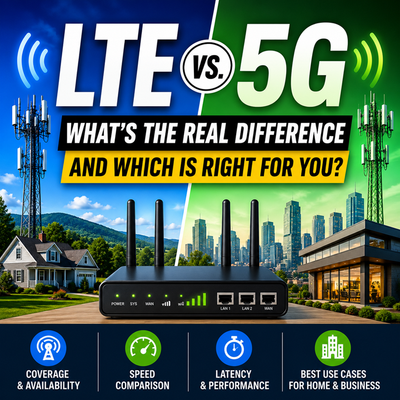
For years, cellular carriers have promoted 5G as the next big leap in wireless connectivity. Commercials often highlight lightning-fast download speeds, ultra-low latency, and futuristic applications that promise to change the way we connect. While many of these claims are true, they can also create the impression that LTE has become outdated or obsolete.
The reality is much more nuanced.
For homeowners using cellular internet as their primary connection and small businesses relying on wireless connectivity for daily operations, the best network is not always determined by whether your router displays "LTE" or "5G." Factors such as signal quality, tower congestion, router capabilities, and antenna placement often have a much greater impact on your actual internet experience.
Understanding how LTE and 5G differ can help you make a smarter purchasing decision and avoid spending money on hardware that may not provide meaningful improvements in your specific location.
What Is LTE?
LTE, short for Long Term Evolution, is the fourth generation (4G) cellular technology that dramatically improved mobile internet speeds compared to previous generations. Introduced more than a decade ago, LTE brought faster downloads, lower latency, and more reliable connections that made activities like HD video streaming, video conferencing, and cloud computing practical over cellular networks.
One of LTE's greatest strengths is its maturity. Cellular providers have spent years expanding and optimizing LTE infrastructure across the country, creating extensive coverage in cities, suburbs, and many rural areas.
Modern LTE networks also incorporate advanced technologies such as Carrier Aggregation and Multiple Input Multiple Output (MIMO), allowing compatible routers to communicate over multiple frequencies simultaneously for better speed and improved reliability.
Even today, LTE remains a dependable option for millions of home users and businesses.
What Is 5G?
5G is the fifth generation of cellular technology, designed to increase network capacity while supporting faster speeds, lower latency, and significantly more connected devices than previous generations.
Rather than simply making LTE faster, 5G introduces new technologies that allow carriers to serve growing numbers of smartphones, computers, IoT devices, and wireless internet customers more efficiently.
However, one common misconception is that all 5G networks perform the same. In reality, there are several different types of 5G deployments, each offering unique strengths and tradeoffs.
The Three Types of 5G:
- Low-Band 5G
Low-band 5G operates on frequencies similar to LTE. Because of these lower frequencies, signals travel farther and penetrate buildings more effectively.
This makes low-band 5G excellent for broad coverage areas, particularly in suburban and rural communities. However, its speeds are often only modestly faster than LTE, and in some situations users may notice very little difference during everyday activities.
- Mid-Band 5G
Mid-band 5G strikes an excellent balance between speed and coverage.
It offers substantially faster download and upload speeds than LTE while still providing respectable coverage distances. Many carriers are rapidly expanding their mid-band deployments, making it one of the most important technologies for fixed wireless home internet services.
For many homeowners and small businesses, mid-band 5G delivers the biggest real-world improvements.
- High-Band 5G (mmWave)
High-band 5G, commonly referred to as millimeter wave or mmWave, delivers incredibly fast speeds and extremely low latency.
The tradeoff is coverage.
These higher frequencies do not travel very far and struggle to penetrate walls, trees, and other obstacles. As a result, mmWave is generally limited to locations such as stadiums, convention centers, airports, and dense urban environments.
Most home users will rarely connect to mmWave during normal daily use.
LTE vs. 5G: A Side-by-Side Comparison:
Although 5G is the newer technology, both networks have strengths depending on where and how you use them.
|
Feature |
LTE |
5G |
|
Coverage |
Excellent |
Excellent, depending on deployment |
|
Typical Download Speeds |
Good |
Faster in many areas |
|
Latency |
Low |
Lower |
|
Network Capacity |
High |
Very High |
|
Rural Availability |
Excellent |
Improving |
|
Urban Performance |
Very Good |
Excellent |
|
Hardware Availability |
Extensive |
Growing rapidly |
It is important to remember that these comparisons represent general trends. Your experience will depend heavily on your carrier's network and the quality of the signal reaching your router.
When LTE Can Be the Better Choice:
Many people are surprised to learn that LTE can outperform 5G under certain conditions.
- Rural Coverage
In many rural communities, LTE infrastructure has been established for years and often provides stronger, more consistent coverage than newly deployed 5G networks.
If your nearest tower primarily serves LTE, upgrading to a 5G router may not produce the dramatic improvement you expect.
- Congested Networks
A crowded 5G network can sometimes deliver slower speeds than a well-performing LTE connection.
Network congestion affects every generation of cellular technology. If hundreds of users are sharing the same tower, available bandwidth must be divided among everyone connected.
Strong LTE Signal vs. Weak 5G Signal:
A router connected to a strong LTE signal frequently delivers a better experience than one struggling to maintain a weak 5G connection.
Reliable signal quality often matters more than simply connecting to the newest network technology.
When 5G Makes Sense:
There are many situations where investing in 5G is absolutely worthwhile.
If your carrier has deployed robust mid-band or high-capacity 5G service in your area, you may experience noticeably faster downloads, better upload performance, and lower latency.
This can make a significant difference for:
- Working from home
- Video conferencing
- Streaming multiple 4K videos
- Cloud backups
- Large file transfers
- Supporting multiple connected users
For growing businesses that expect increased bandwidth demands over the coming years, investing in 5G-capable equipment can also help future-proof their network.
Why Signal Quality Is More Important Than Network Generation:
One of the biggest misconceptions about cellular internet is that the network label tells the whole story.
In reality, engineers evaluate signal quality using measurements such as:
- RSRP (Reference Signal Received Power): Indicates how strong the cellular signal is.
- RSRQ (Reference Signal Received Quality): Measures overall signal quality and interference.
- SINR (Signal-to-Interference-plus-Noise Ratio): Reflects how clean the signal is relative to surrounding noise.
A strong LTE connection with excellent RSRP, RSRQ, and SINR values can often outperform a weak 5G connection suffering from poor signal conditions.
Improving these signal metrics often results in faster speeds, lower latency, fewer dropped connections, and a more consistent internet experience.
How External Antennas Improve Both LTE and 5G:
Whether you're using LTE or 5G, an external antenna can significantly improve the quality of your cellular connection when installed correctly.
Unlike Wi-Fi extenders, external cellular antennas do not create signal where none exists. Instead, they help your router receive a cleaner, stronger signal from the nearest cellular tower.
Depending on your location, an external antenna may help:
- Improve download and upload speeds
- Increase signal quality
- Reduce dropped connections
- Improve video conferencing stability
- Enhance streaming performance
- Increase connection consistency during peak usage hours
For homes located farther from a cellular tower or buildings with metal siding, concrete walls, or energy-efficient windows, an external antenna can often provide noticeable improvements.
Choosing the Right Router:
Selecting the right router involves more than choosing LTE or 5G.
Homeowners and small businesses should also consider features such as external antenna support, Ethernet connectivity, Wi-Fi capabilities, and the number of cellular antenna ports available.
Enterprise-grade routers, including many models available through AntennaGear, are built for continuous operation and often provide more advanced networking features than consumer-grade hotspots supplied by cellular carriers.
When paired with a properly matched external antenna, these routers can provide reliable internet connectivity for everything from remote work and retail businesses to home offices and backup internet connections.
What This Means for You:
The choice between LTE and 5G is not as simple as selecting the newest technology. Both networks are capable of delivering fast, reliable internet when paired with the right equipment and deployed in the right environment.
For many homeowners and small businesses, LTE continues to provide excellent performance thanks to its mature infrastructure and widespread coverage. At the same time, 5G is opening the door to faster speeds, greater capacity, and exciting new possibilities where coverage is available.
The key is understanding that your internet experience depends on far more than the network name displayed on your router. Signal quality, router capabilities, antenna selection, and proper installation all play a major role in achieving reliable performance.
If you're considering upgrading your cellular internet setup or want to improve the performance of your existing LTE or 5G connection, explore the selection of enterprise-grade routers, external antennas, and accessories available at AntennaGear.net. Our team is here to help you find the right solution for your home or small business so you can get the most from your cellular connection.