
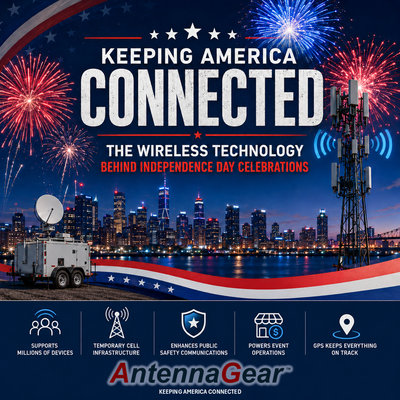
Keeping America Connected: The Wireless Technology Behind Independence Day Celebrations
Posted by Gordon R. on 2nd Jul 2026
Every Fourth of July, millions of Americans gather with family, friends, and neighbors to celebrate Independence Day. From hometown parades and community festivals to concerts and spectacular fireworks displays, these events bring people together to celebrate our nation's history and traditions.
While the fireworks often take center stage, there is another incredible display happening behind the scenes. Thousands of pieces of wireless technology work together to keep these celebrations running smoothly. Cellular networks support millions of smartphone users, public safety agencies coordinate emergency response, vendors process electronic payments, and event organizers rely on dependable communications to manage every aspect of the celebration.
Most attendees never notice this invisible infrastructure, but without it, many of today's Independence Day events simply would not function as seamlessly as they do. At AntennaGear, we understand the important role wireless connectivity plays in keeping people, businesses, and communities connected every day. Independence Day provides a perfect opportunity to appreciate the technology that helps make these celebrations possible.
Millions of Devices Sharing the Same Network:
Large public gatherings create one of the biggest challenges for wireless networks. A local fireworks show may attract several thousand visitors, while major celebrations in large cities can draw hundreds of thousands of people, all carrying smartphones, tablets, smartwatches, and other connected devices.
Throughout the evening, attendees are constantly using their devices to:
- Capture and share photos and videos
- Stream portions of the event live
- Navigate using mapping applications
- Coordinate meeting locations with friends and family
- Access digital event information
- Make purchases through mobile payment systems
Every one of these activities consumes network resources. During major events, wireless carriers often experience traffic levels far above normal daily usage. To prepare, carriers spend weeks planning for these predictable spikes in demand by increasing available network capacity and strategically positioning additional infrastructure where it will have the greatest impact.
The goal is simple: keep everyone connected, even when tens of thousands of devices are trying to communicate simultaneously.
Temporary Cellular Infrastructure Steps In:
One of the most interesting aspects of large public events is that the existing cellular network isn't always enough to support the increased demand. When attendance exceeds the capacity of nearby cell towers, carriers often deploy temporary cellular infrastructure.
You may have heard of Cell on Wheels (COW) or Cell on Light Truck (COLT) systems. These portable cellular sites can be quickly transported to an event and activated to provide additional coverage and capacity. Equipped with antennas, radios, and supporting equipment, these temporary installations act as supplemental cell sites that help distribute network traffic more efficiently.
These deployments are especially common at:
- Large fireworks displays
- State fairs
- Music festivals
- Sporting events
- Emergency response operations
- Disaster recovery efforts
Antennas play a critical role in these temporary deployments. Proper antenna placement and carefully selected antenna designs help maximize coverage, reduce interference, and improve overall network performance. Every deployment is engineered to provide the best possible service for the expected crowd.
Reliable Communications Support Public Safety:
Independence Day celebrations require careful coordination among numerous public safety organizations. Police officers, firefighters, emergency medical personnel, traffic management teams, and event security all rely on dependable communications throughout the event.
While traditional land mobile radio systems remain an essential part of public safety communications, cellular data networks have become increasingly important for supporting modern emergency operations.
Today's first responders frequently use cellular connectivity for:
- Mobile mapping and navigation
- Accessing incident information
- Sharing photos and reports
- Coordinating personnel
- Monitoring traffic conditions
- Accessing cloud-based applications
Reliable wireless connectivity allows responders to receive and share critical information quickly, helping them make informed decisions while maintaining situational awareness throughout the event.
Wireless Networks Keep Events Running Behind the Scenes:
Many attendees assume wireless networks are only there for the public, but event organizers often depend on them just as much.
Temporary internet connectivity is commonly used to support event operations where wired broadband may not be available or practical. Cellular routers paired with external antennas provide flexible internet access that can be deployed almost anywhere.
These connections often support:
- Mobile point-of-sale systems
- Food and beverage vendors
- Ticket scanning equipment
- Digital information displays
- Security camera systems
- Temporary offices
- Vendor communications
Whether it's processing credit card transactions or monitoring equipment remotely, reliable wireless connectivity helps ensure that event operations continue without interruption.
GPS Technology Does More Than Guide You to the Fireworks:
Most people associate GPS with turn-by-turn navigation, but its role during large public events extends much further.
Event organizers often use GPS technology to coordinate equipment deliveries, monitor vehicle locations, and improve overall logistics. Emergency vehicles depend on accurate positioning to reach incidents quickly, while support crews can track assets and equipment throughout the event.
GPS also plays an important role in precise timing and synchronization for many wireless systems. Accurate timing helps support network coordination and allows numerous technologies to operate together efficiently.
Behind every accurate GPS receiver is an antenna designed to receive extremely weak satellite signals from thousands of miles above the Earth. Although these antennas are often overlooked, they are a fundamental part of maintaining dependable positioning information.
Why External Antennas Matter:
As wireless networks become more sophisticated, antenna performance becomes increasingly important.
A common misconception is that antennas simply make signals "stronger." In reality, a properly designed external antenna helps networking equipment receive a cleaner, higher-quality signal. Better signal quality allows cellular modems and routers to communicate more efficiently with nearby cell towers, improving reliability and overall performance.
This becomes especially important during crowded events where network resources are being shared among thousands of users.
External antennas can benefit a wide variety of deployments, including:
- Temporary event networking
- Mobile command centers
- Construction trailers
- Food trucks
- Fleet vehicles
- Rural internet installations
- Backup internet systems
When paired with enterprise-grade networking equipment, the right antenna solution can help maintain reliable connectivity even in challenging RF environments.
*Browse and Shop AntennaGear's full line of external Cellular, Wi-Fi, GPS, and Bluetooth antennas at AntennaGear.net
Planning for the Unexpected:
Large public events require extensive contingency planning. Organizers prepare not only for large crowds but also for changing weather, equipment failures, traffic issues, and unexpected emergencies.
Wireless networking provides the flexibility needed to adapt quickly when conditions change. Backup internet connections, portable networking equipment, and mobile command centers allow organizers to maintain communications if primary systems become unavailable.
Many organizations rely on enterprise cellular routers equipped with high-performance external antennas because they provide dependable connectivity that can be deployed rapidly and relocated as operational needs evolve.
This level of flexibility has become increasingly valuable as more event management systems depend on reliable internet access.
The Framework Behind Every Celebration:
When families gather to watch fireworks, enjoy local festivals, or attend community celebrations, few people think about the enormous amount of planning and technology operating behind the scenes.
Network engineers optimize cellular coverage months before major events. Wireless technicians deploy temporary infrastructure. Public safety agencies coordinate communications across multiple organizations. Utility crews, transportation departments, and event staff all work together to ensure everything operates safely and efficiently.
The antennas, routers, cellular networks, GPS systems, and wireless infrastructure supporting these efforts rarely receive public recognition, yet they play an essential role in helping millions of Americans celebrate together each year.
What This Means for You:
While most people associate advanced wireless networking with large public events, the same technologies are available to businesses, remote workers, municipalities, fleet operators, and homeowners every day.
Whether you're building a reliable backup internet solution, improving connectivity at a remote job site, supporting a mobile business, or extending coverage in a rural location, enterprise-grade cellular equipment and properly matched external antennas can significantly improve network performance and reliability.
At AntennaGear, we specialize in helping customers find the right antenna solutions for cellular routers, gateways, mobile hotspots, and enterprise networking equipment. From permanent installations to temporary deployments, our goal is to help you achieve dependable wireless connectivity wherever your work or adventures take you.
As you celebrate Independence Day with family and friends, take a moment to appreciate not only the fireworks overhead but also the remarkable wireless infrastructure quietly working behind the scenes. It is this combination of engineering, innovation, and reliable connectivity that helps keep America connected, today and every day.