
Is Your Business Prepared for an Internet Outage?
Posted by Gordon R. on 24th Nov 2026
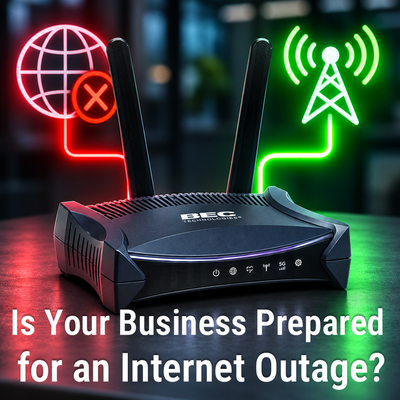
Imagine it's the middle of a busy workday when your internet connection suddenly goes down. Credit card terminals stop processing transactions, employees lose access to cloud-based applications, phones stop ringing, and customers are left waiting. What initially seems like a minor inconvenience quickly becomes a significant disruption to your business. As businesses become increasingly dependent on internet connectivity, maintaining a reliable connection is no longer simply a matter of convenience. It is a fundamental part of keeping a business operational. Fortunately, implementing a backup internet connection through cellular failover is more accessible than many business owners realize.
The Real Cost of Internet Downtime:
An internet outage affects considerably more than your ability to browse the web or send an email. Modern businesses rely on internet connectivity for payment processing, inventory management, customer communications, security systems, remote monitoring, and countless other daily operations. Even a relatively short outage can result in lost revenue, reduced employee productivity, and frustrated customers. For businesses that rely heavily on cloud-based infrastructure, an extended outage can bring nearly every aspect of their operations to a standstill. When considering the potential financial impact of an internet outage, the cost of implementing a backup connection can become much easier to justify.
Even the Best Internet Providers Experience Outages:
Regardless of how much you spend on your internet service or how reliable your provider has historically been, no internet connection is completely immune to failure. Construction crews can accidentally sever underground fiber lines, severe weather can damage infrastructure, networking equipment can malfunction, and upstream service disruptions can leave entire communities without connectivity. Upgrading from a 300 Mbps internet connection to a gigabit fiber connection may improve network performance, but it does not necessarily improve network availability. Speed and reliability are two fundamentally different characteristics of an internet connection. Establishing redundancy through an independent secondary connection is one of the most effective ways to reduce your exposure to unexpected service interruptions.
What Is Cellular Failover and How Does It Work?
Cellular failover is a networking configuration that utilizes an LTE or 5G cellular connection as a secondary internet source when the primary connection becomes unavailable. Rather than requiring employees to manually connect their computers to a mobile hotspot or wait for their internet service provider to resolve an issue, a properly configured failover system can automatically redirect network traffic through a cellular connection.
A typical cellular failover configuration operates as follows:
- Your business operates normally using its primary internet connection.
- Your router continuously monitors the health and availability of that connection.
- If the primary connection fails, the router detects the interruption through configured network health checks.
- Network traffic is automatically redirected through the secondary LTE or 5G connection.
- Essential business operations continue through the cellular network.
- Once the primary connection is restored and stable, the router can automatically redirect traffic back to it.
Depending on the equipment and network configuration, this transition can occur within seconds. While some active connections, such as VPN sessions, VoIP calls, or ongoing transactions, may need to reconnect due to a change in public IP address or network routing, cellular failover can substantially reduce the duration and severity of an internet outage.
Why Cellular Makes an Excellent Backup Internet Connection:
One of the greatest advantages of cellular failover is that it introduces a different method of delivering internet connectivity to your business. While subscribing to a second wired internet provider may seem like an effective solution, multiple providers can sometimes share the same underground conduits, utility poles, or upstream infrastructure. A single incident could potentially disrupt both connections simultaneously. Cellular connectivity reduces dependence on this shared last-mile infrastructure by establishing a wireless connection between your business and a cellular base station. Modern LTE and 5G networks can provide sufficient bandwidth to support many essential business applications, including payment processing, cloud-based software, email, and voice communications. Cellular networks are not immune to outages or congestion themselves, but introducing a different connectivity medium can significantly improve overall network resilience.
Your Backup Connection Is Only as Reliable as Its Signal:
Purchasing a cellular-capable router does not automatically guarantee a dependable backup internet connection. Business networking equipment is frequently installed inside server rooms, equipment cabinets, basements, warehouses, or commercial buildings constructed with materials that attenuate radio frequency signals. Concrete, steel, metal roofing, and energy-efficient windows can all contribute to reduced cellular reception. Additionally, signal strength alone does not necessarily indicate the quality or reliability of a cellular connection.
Several RF measurements can help determine the health of your cellular connection:
|
RF Metric |
What It Measures |
|
RSRP (Reference Signal Received Power) |
The received power of cellular reference signals. |
|
RSRQ (Reference Signal Received Quality) |
Reference signal quality relative to total received power. |
|
SINR (Signal-to-Interference-plus-Noise Ratio) |
The relationship between the desired signal, interference, and noise. |
|
RSSI (Received Signal Strength Indicator) |
Total received power within the measured bandwidth, including interference and noise. |
A cellular router may indicate strong signal strength while still experiencing poor throughput, elevated latency, or inconsistent performance due to interference, congestion, or unfavorable RF conditions. Evaluating these measurements collectively, alongside actual network performance, provides a more comprehensive understanding of whether your cellular connection is capable of supporting your business during an outage.
How External Antennas Improve Cellular Failover Reliability:
External cellular antennas allow businesses to establish a more favorable RF environment without necessarily relocating their networking equipment. Rather than relying on antennas positioned inside a server cabinet or deep within a commercial building, an external antenna can be installed near a window, on an exterior wall, or above the roofline, where fewer physical obstructions may exist between the antenna and the cellular base station. A properly selected antenna system can improve the cellular link budget, enhance signal quality, and help maintain more consistent connectivity.
When selecting an external antenna for a cellular failover application, consider the following:
- Frequency coverage compatible with the cellular modem and carrier's operating bands.
- Appropriate 2x2 or 4x4 MIMO antenna configurations.
- Omnidirectional or directional radiation patterns based on the deployment environment.
- Antenna placement, mounting height, and surrounding obstructions.
- Coaxial cable attenuation, cable length, and connector compatibility.
- Environmental protection for outdoor antenna installations.
It is important to remember that higher antenna gain does not automatically translate into better performance in every environment. Antenna radiation patterns, installation location, interference levels, and transmission line losses all influence the effectiveness of an antenna system. In a cellular failover application, the objective should not necessarily be achieving the highest possible download speed, but establishing a stable, consistent connection that your business can depend on when its primary internet service becomes unavailable.
Choosing the Right Cellular Failover Equipment:
Implementing cellular failover does not necessarily require replacing your entire network infrastructure. Manufacturers such as Ericsson Cradlepoint, Semtech Sierra Wireless, Digi, Inseego, and BEC Technologies offer cellular networking solutions that can accommodate a variety of business environments and network architectures. From dedicated cellular adapters that integrate with existing routers to enterprise-grade cellular routers with multiple WAN interfaces, businesses have several options for establishing network redundancy.
|
Equipment Type |
Primary Benefit |
|
Dedicated cellular adapter |
Adds cellular connectivity to compatible existing network infrastructure. |
|
Integrated cellular router |
Combines primary WAN routing and cellular failover within a single device. |
|
Dual SIM cellular router |
Allows switching between cellular subscriptions or carriers. |
|
Dual modem cellular router |
Supports more advanced redundancy through independent cellular modems. |
|
External MIMO antenna system |
Helps optimize cellular RF performance and connection reliability. |
Businesses requiring additional redundancy may also benefit from utilizing multiple cellular carriers. However, it is important to understand that a dual SIM router does not necessarily contain two cellular modems. Many dual SIM devices must disconnect from one cellular network before establishing a connection with another, while dual modem solutions can potentially maintain simultaneous cellular connections, depending on their hardware and configuration.
Does Your Backup Internet Need to Be as Fast as Your Primary Connection?
Not necessarily. The primary purpose of a backup internet connection is to maintain business continuity rather than replicate the maximum performance of your primary internet service. A business utilizing a gigabit fiber connection may only require a fraction of that bandwidth to maintain payment processing, email communications, inventory management, and other essential services during an outage. Network administrators can utilize Quality of Service (QoS), traffic prioritization, and WAN-specific network policies to allocate available cellular bandwidth more effectively. Temporarily restricting activities such as large file transfers, automatic software updates, cloud backups, and nonessential video streaming can help preserve bandwidth for critical business operations while also minimizing unnecessary cellular data consumption.
Don't Forget About Power Redundancy:
A secondary internet connection provides little benefit if the networking equipment itself loses power. While cellular failover protects against certain types of internet service interruptions, an uninterruptible power supply (UPS) can help maintain power to routers, cellular adapters, network switches, wireless access points, and other essential networking equipment during an electrical outage. Depending on the capacity of the UPS and the power consumption of the connected equipment, businesses may be able to maintain connectivity through short-term power interruptions. Combining internet redundancy with power redundancy creates a more comprehensive approach to business continuity, provided the cellular network and other necessary infrastructure remain operational.
Test Your Backup Plan Before You Need It:
One of the most overlooked aspects of cellular failover is routine testing. Installing a backup internet connection and assuming it will work when needed can leave your business vulnerable to unexpected configuration issues, inactive cellular subscriptions, insufficient bandwidth, or poor RF performance. Periodically simulating a primary internet outage allows businesses to verify that traffic is properly redirected, essential applications remain accessible, and the cellular connection can accommodate realistic network demands. Regularly monitoring cellular signal quality, inspecting external antenna connections, maintaining active data plans, and verifying automatic failback functionality can help ensure that the system remains ready when needed. The middle of an internet outage is not the ideal time to discover that your backup connection doesn't work.
What This Means for You:
Internet connectivity has become as fundamental to many modern businesses as electricity itself. While it may be impossible to prevent every internet outage, it is entirely possible to reduce the impact those outages have on your daily operations. Implementing cellular failover, selecting appropriate networking equipment, and optimizing cellular RF performance through properly configured external antenna solutions can help establish a more resilient network infrastructure. At AntennaGear.net, we offer a wide range of device-specific LTE and 5G antenna solutions designed to support cellular failover, business continuity, and fixed wireless connectivity across a variety of deployment environments. Investing in a reliable backup internet connection today could be the difference between continuing business as usual and closing your doors during your next unexpected internet outage.