
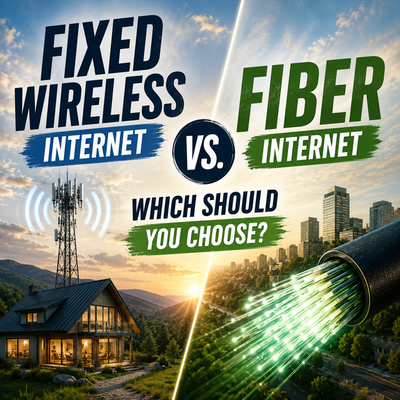
Fiber vs. Fixed Wireless Internet: Understanding the Pros and Cons
Posted by Gordon R. on 31st Jul 2026
Internet access has become essential for everything from remote work and online learning to streaming entertainment and running a small business. As demand for fast, dependable connectivity continues to grow, homeowners and business owners have more choices than ever before.
Fiber internet is often considered the gold standard because of its speed and consistency, but it isn't available everywhere. Fixed Wireless Internet (FWA), powered by LTE and 5G cellular networks, has quickly become a compelling alternative that can deliver broadband speeds without requiring new cables to be installed.
Introduce the idea that there isn't a one-size-fits-all answer. The best option depends on where you live, how you use the internet, your budget, and what infrastructure is available in your area.
What Is Fiber Internet?
Explain how fiber-optic internet transmits data using pulses of light through dedicated fiber cables, allowing for extremely high bandwidth and low latency.
Discuss why fiber has earned its reputation for delivering consistent performance, symmetrical upload and download speeds, and excellent reliability. While it remains the preferred solution for many users, availability is still limited in numerous suburban and rural communities.
What Is Fixed Wireless Internet?
Introduce Fixed Wireless Access (FWA) as broadband internet delivered over LTE or 5G cellular networks instead of physical cables.
Explain that a compatible cellular modem or router communicates with a nearby cellular tower to provide internet access throughout the home or business. As carriers continue expanding their 5G networks, Fixed Wireless Internet has become a realistic broadband solution for millions of customers.
How Fiber and Fixed Wireless Deliver Internet:
Although both technologies provide high-speed internet, they use completely different infrastructures.
Explain how fiber relies on a dedicated wired connection running directly to the property, while Fixed Wireless connects wirelessly to a nearby cellular tower. Discuss how these different delivery methods affect installation, availability, and flexibility.
Speed Comparison:
Compare realistic expectations rather than advertised maximum speeds.
Discuss how fiber consistently delivers extremely fast download and upload speeds with very little fluctuation throughout the day.
Then explain that Fixed Wireless Internet can easily support common household and business activities such as video conferencing, streaming, cloud applications, and remote work. Actual performance depends on factors including signal quality, carrier infrastructure, and network congestion.
Emphasize that many households never fully utilize gigabit fiber speeds during normal daily use.
Reliability:
Reliability is about much more than maximum speed.
Explain that fiber generally offers very consistent performance because it is not affected by cellular tower congestion. However, physical cable damage, construction accidents, and provider maintenance can still cause service interruptions.
For Fixed Wireless Internet, discuss how connection quality depends heavily on signal strength and network conditions. Introduce the idea that enterprise-grade routers and properly selected external antennas can significantly improve reliability in challenging locations.
Installation and Availability:
Availability is often where the biggest differences become apparent.
Discuss how fiber requires extensive underground or aerial infrastructure, making it unavailable in many communities.
By comparison, Fixed Wireless Internet can often be activated much more quickly anywhere there is adequate cellular coverage. This makes it an attractive solution for rural homes, temporary offices, vacation properties, and locations where installing fiber may not be practical.
Cost Considerations:
Rather than focusing on exact pricing, explain the different types of costs associated with each service.
Discuss installation fees, equipment rentals, and monthly service costs commonly associated with fiber.
Then compare those with the potential purchase of a cellular router and optional external antenna for Fixed Wireless Internet. Explain that while pricing varies widely between providers, understanding the total cost of ownership is often more valuable than comparing monthly service fees alone.
Which Option Is Best for Your Needs?
Rather than declaring one technology superior, explain which situations each serves best.
Fiber is an outstanding choice for users who regularly transfer massive files, operate bandwidth-intensive businesses, or simply have access to an affordable fiber provider.
Fixed Wireless Internet excels for homeowners without fiber availability, rural properties, home offices, small businesses, backup internet connections, and locations that require flexibility without extensive infrastructure.
Encourage readers to evaluate their actual internet usage rather than assuming they need the fastest service available.
Getting the Most from Fixed Wireless Internet:
Transition naturally into AntennaGear's expertise.
Explain that the quality of the equipment often plays a significant role in the overall user experience. Discuss the benefits of enterprise-grade LTE and 5G routers, proper router placement, and external antennas for improving signal quality and maintaining a more stable connection.
Briefly introduce technologies such as MIMO and explain how optimizing signal quality can improve both speed and reliability.
Can Fixed Wireless Replace Fiber?
Address one of the most common questions surrounding FWA.
Explain that for many homes and small businesses, the answer is increasingly yes. Modern LTE and especially 5G Fixed Wireless services provide more than enough bandwidth for everyday internet use.
However, users with exceptionally demanding workloads, such as professional video production, enterprise data transfers, or other bandwidth-intensive applications, may still benefit from fiber's greater capacity and consistency.
The Future of Broadband:
Discuss how both technologies will continue to play important roles in expanding broadband access.
Explain that fiber deployment continues to grow while carriers simultaneously invest heavily in LTE and 5G infrastructure. As enterprise cellular hardware continues to improve, Fixed Wireless Internet is becoming an increasingly capable primary internet solution rather than simply a backup option.
What This Means for You:
Conclude by reinforcing that choosing between fiber and Fixed Wireless Internet is about selecting the solution that best matches your needs, not simply choosing the newest or fastest technology.
Fiber remains the benchmark for raw performance where it is available, but Fixed Wireless Internet has matured into a dependable, high-speed option for homes and small businesses across the country. With the right equipment, many users can enjoy excellent performance without waiting for fiber infrastructure to reach their neighborhood.
Finish by inviting readers to explore AntennaGear.net for enterprise-grade LTE and 5G routers, external antennas, and accessories designed to help maximize Fixed Wireless Internet performance. Whether you're replacing traditional broadband or improving an existing cellular connection, the right hardware can make a significant difference.