

Why Antenna Mounting Surfaces and Ground Planes Matter
Posted by Gordon Reed on 10th Mar 2026
When evaluating antenna performance, most people focus on specifications like gain, supported frequency bands, or cable loss. These factors certainly matter, but one of the most important elements of an antenna system is often overlooked entirely: the surface the antenna is mounted on.
For many antenna designs, especially mobile and low-profile omnidirectional antennas, the mounting surface is not simply a mechanical support. It is an active electrical component of the antenna system.
This surface functions as what RF engineers refer to as a ground plane, and it plays a critical role in determining how efficiently an antenna radiates, how well it matches system impedance, and how consistent the radiation pattern will be.
Understanding how mounting surfaces influence antenna performance can help prevent installation mistakes that reduce signal quality, limit coverage, or create inconsistent connectivity.
What Is a Ground Plane?:
A ground plane is a conductive surface that acts as part of the antenna system. In many antenna designs, particularly quarter-wave monopole antennas, the ground plane effectively forms the missing half of the antenna.
To understand this concept, it helps to compare two common antenna structures.
A half-wave dipole antenna consists of two radiating elements of equal length. Each element represents one quarter of the wavelength, forming a balanced antenna system.
A quarter-wave monopole antenna, however, only contains one physical radiating element. The ground plane beneath it acts as the electrical mirror of the missing half of the antenna. Through electromagnetic reflection, the ground plane creates what RF engineers call an image antenna, allowing the system to behave similarly to a half-wave dipole.
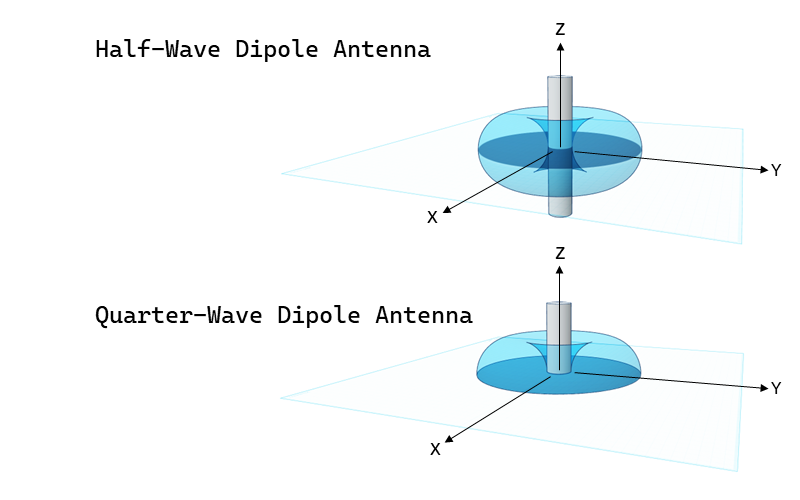
This phenomenon is explained through image theory, which describes how conductive surfaces reflect electromagnetic fields and influence current distribution.
The ground plane provides several critical functions:
- It stabilizes antenna impedance
- It shapes the radiation pattern
- It improves radiation efficiency
- It helps maintain proper antenna resonance
Without an appropriate ground plane, the antenna system cannot operate as it was originally designed.
Why Mounting Surfaces Directly Affect Antenna Performance:
Because the ground plane is part of the antenna system, the mounting surface has a direct influence on several key RF parameters.
Impedance Matching
Most RF systems are designed around a 50-ohm impedance standard. Antennas are tuned during design and manufacturing to match this impedance when installed on an appropriate ground plane.
If the antenna is mounted on a surface that does not provide the expected ground plane, the impedance can shift away from the intended value. This leads to higher Voltage Standing Wave Ratio (VSWR) and reflected power within the system.
Higher VSWR reduces transmit efficiency and can degrade overall system performance.
Radiation Pattern Stability
An ideal omnidirectional antenna produces a uniform radiation pattern around the horizontal plane. A properly sized and symmetrical ground plane helps maintain this pattern.
If the ground plane is too small or asymmetrical, the radiation pattern can become distorted. The antenna may begin favoring certain directions while creating signal nulls in others.
This can produce inconsistent connectivity even when signal strength appears adequate in some areas.
Reduced Efficiency
When an antenna lacks the conductive surface it was designed to work against, it cannot effectively radiate RF energy. Instead of transmitting efficiently into free space, energy may be lost through mismatch or absorbed into surrounding structures.
This reduction in efficiency often appears as weaker signal levels and reduced coverage range.
Frequency Detuning
Antennas are tuned to operate within specific frequency bands. The electrical characteristics of the ground plane are part of this tuning process.
If the antenna is installed on a surface that does not provide the expected electrical environment, the resonant frequency of the antenna can shift. This detuning can reduce performance across the intended bands.
Common Mounting Surfaces and Their RF Behavior:
Different mounting surfaces can produce very different antenna performance results.
Metal Vehicle Roofs
Metal vehicle roofs provide one of the best ground planes available for mobile antennas.
They offer:
- A large conductive surface
- Symmetrical geometry around the antenna
- Consistent electrical contact
Because of these properties, vehicle roofs are commonly used for cellular, GPS, and Wi-Fi antennas in applications such as fleet vehicles, emergency response vehicles, and industrial service trucks.
When antennas are mounted near the center of the roof, the radiation pattern is typically very uniform.
Metal Equipment Cabinets
Metal enclosures can also function as ground planes, although the performance depends on the size of the surface and the antenna's location.
Mounting an antenna near the center of a large metal cabinet often produces acceptable results. However, mounting near edges or corners can distort the radiation pattern due to asymmetry.
Non-Conductive Surfaces
Plastic, fiberglass, and wood do not provide a conductive ground plane.
If an antenna designed for ground plane operation is mounted on these materials, performance will often degrade. This situation frequently occurs in installations involving:
- Fiberglass boats
- Plastic enclosures
- RV rooftops
- Composite industrial structures
In these environments, installers may need to use antennas designed to operate without a ground plane or add a conductive mounting plate.
Magnetic Mounts
Magnetic mount antennas rely on the metal surface beneath the magnet to serve as the ground plane.
These mounts are commonly used for temporary installations on vehicle roofs. As long as the magnet sits on a sufficiently large conductive surface, the antenna typically performs as intended.
See All Antenna Mounting Options at AntennaGear.net
Antenna Types That Require Ground Planes:
Several antenna designs rely heavily on ground plane interaction.
Quarter-Wave Monopole Antennas
Quarter-wave monopole antennas are among the most common antenna types used in cellular and RF communications.
Examples include:
- Cellular whip antennas
- LTE and 5G mobile antennas
- VHF and UHF mobile radio antennas
These antennas require a conductive ground plane to complete the antenna system electrically.
Low-Profile Mobile Antennas
Many low-profile “puck” style antennas contain internal monopole structures. These designs rely on the vehicle roof or mounting surface to provide the necessary ground plane.
Without it, gain and efficiency may drop significantly.
Combination Antennas
Multi-function antennas that combine cellular, Wi-Fi, and GNSS elements may also rely on the mounting surface as part of the antenna system.
Antenna Types That Do Not Require Ground Planes:
Not all antennas depend on mounting surfaces for proper operation.
Ground Plane Independent Antennas
Some antenna designs include internal counterpoise structures that replace the need for an external ground plane. These antennas are specifically engineered for installations on non-metal surfaces.
Dipole Antennas
Dipole antennas contain both halves of the radiating structure within the antenna assembly itself. Because of this, they do not rely on an external conductive surface.
Directional Antennas
Directional antennas typically include their own radiating elements and reflector structures.
Examples include:
- Panel antennas
- Yagi antennas
- Log-periodic antennas
These antennas produce their radiation patterns through internal element geometry rather than through interaction with a mounting surface.
Ground Plane Size Considerations:
The size of the ground plane relative to the wavelength of operation plays an important role in antenna performance.
A common rule of thumb is that the ground plane should extend at least one quarter wavelength from the base of the antenna in all directions.
For example:
|
Frequency |
Approximate Quarter Wavelength |
|
700 MHz |
~4.2 inches |
|
2.4 GHz |
~1.2 inches |
|
5 GHz |
~0.6 inches |
When the ground plane is smaller than this guideline, radiation patterns can become distorted and antenna efficiency can drop.
This becomes particularly important for antennas operating at lower cellular frequencies, where wavelengths are longer and the required ground plane size increases.
Common Installation Mistakes:
Many antenna performance issues originate from installation decisions rather than antenna quality.
Common mistakes include mounting antennas on plastic or fiberglass surfaces when the antenna requires a ground plane, placing antennas near the edges of metal structures, and installing multiple antennas too close together.
Nearby metal objects such as ladder racks, rails, or roof structures can also interfere with the antenna’s radiation pattern by reflecting or absorbing RF energy.
Even small placement changes can have measurable effects on signal quality.
Practical Installation Tips:
To maximize antenna performance, consider the following best practices.
Mount antennas near the center of the available conductive surface whenever possible. This helps maintain symmetrical radiation patterns.
Avoid placing antennas directly next to edges or vertical metal structures. These features can distort the radiation pattern.
Maintain adequate spacing between antennas, especially in multi-antenna systems used for MIMO cellular and Wi-Fi applications.
If the mounting surface is plastic, fiberglass, or another non-conductive material, choose antennas specifically designed to operate without a ground plane.
Finally, ensure that the antenna mount makes proper electrical contact with the metal surface. Paint, coatings, or insulating materials can sometimes interfere with this connection.
What This Means for You:
The mounting surface of an antenna is not just a structural detail. In many cases, it is an essential part of the antenna system itself.
Ignoring the role of the ground plane can lead to reduced signal strength, distorted coverage patterns, and inefficient RF performance, even when using a high-quality antenna.
By understanding how ground planes work and choosing appropriate mounting locations, it is possible to significantly improve the performance and reliability of wireless systems.
For more antenna installation guidance and antenna solutions designed for routers, gateways, and IoT devices, visit AntennaGear.net.