
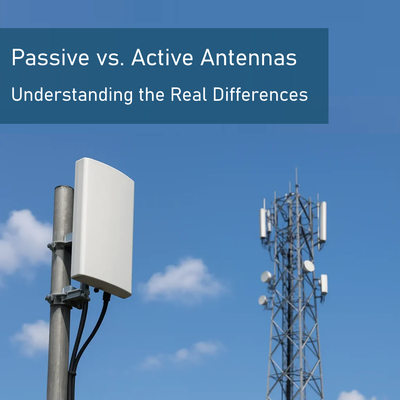
Passive vs. Active Antennas, Understanding the Real Differences
Posted by Gordon Reed on 24th Mar 2026
In RF system design, the distinction between passive and active antennas is often misunderstood, and in many cases, misrepresented. While both serve the same fundamental purpose, transmitting and receiving electromagnetic energy, the way they interact with the signal chain is fundamentally different.
For applications spanning cellular, Wi-Fi, and GNSS, understanding this difference is critical. It impacts system noise figure, cable loss tolerance, power requirements, and ultimately, overall link performance.
What is a Passive Antenna?
A passive antenna is a radiating element that contains no active electronic components. It does not amplify or condition the signal in any way. Instead, it operates purely as a transducer between guided and free-space electromagnetic waves.
Key Characteristics
- No external power required
- Performance defined by physical design:
- Gain (dBi)
- Radiation pattern
- Polarization
- Bandwidth and impedance matching
- Subject to system losses:
- Conductor and dielectric losses
- Feedline attenuation
Common Examples
- Omni-directional antennas such as monopoles and dipoles
- Directional antennas such as panel, Yagi, and log-periodic designs
- Multi-port MIMO antennas for LTE and 5G
Where Passive Antennas Excel
Passive antennas are the standard for most RF systems, including:
- Cellular routers and gateways
- Wi-Fi infrastructure
- Fixed wireless and mobility deployments
Their simplicity and reliability make them the preferred choice in the vast majority of applications.
What is an Active Antenna?
An active antenna integrates electronic components directly into the antenna assembly. The most common component is a Low Noise Amplifier, placed as close as possible to the radiating element.
These antennas require DC power, typically delivered through the coaxial cable using a bias tee.
Key Characteristics
- Requires external power
- Provides amplification at or near the antenna
- Often includes:
- Low Noise Amplifier (LNA)
- Filtering
- Impedance matching circuitry
Why Active Designs Exist
Active antennas are used to improve signal integrity in situations where:
- Received signal levels are extremely low
- Cable losses would otherwise degrade the signal beyond usability
GPS and GNSS Antennas, A Special Case:
GPS and GNSS systems operate with some of the weakest signals encountered in RF engineering. At the Earth’s surface, these signals are often in the range of -130 dBm to -160 dBm.
Because of this, many GPS antennas are active by design.
How Active GPS Antennas Work
- A passive patch antenna receives the signal
- An integrated LNA amplifies it immediately
- Filtering ensures only desired GNSS bands are passed
This amplification occurs before the signal encounters feedline loss, preserving signal integrity.
Important Clarification
The radiating element itself remains passive. The antenna is classified as active due to the integrated electronics.
Passive vs. Active Antennas, Key Differences:
Power Requirements
- Passive antennas require no power
- Active antennas require DC bias
Signal Behavior
- Passive antennas do not amplify signals
- Active antennas provide gain at the antenna
Noise Performance
- Passive systems rely on receiver sensitivity and system losses
- Active antennas can improve system noise figure when properly designed
Cable Loss Impact
- Passive antennas are directly affected by feedline attenuation
- Active antennas can offset cable loss with amplification
System Complexity
- Passive systems are simpler and more robust
- Active systems require compatibility with power and RF design constraints
When to Use Passive Antennas:
Passive antennas are ideal for most deployments, particularly when:
- Cable runs are short to moderate
- The receiver has adequate sensitivity
- Simplicity and reliability are priorities
Engineering Best Practices
- Optimize antenna placement for line-of-sight and minimal obstruction
- Match antenna type to application, omni for coverage, directional for gain and focus
- Minimize feedline loss using appropriate coax, such as low-loss cables comparable to LMR-class constructions
When Active Antennas Make Sense:
Active antennas are best suited for specialized scenarios:
- GNSS applications where signals are extremely weak
- Installations with long cable runs
- Systems requiring improved signal-to-noise ratio before the receiver
Important Considerations
- Excessive gain can cause receiver overload
- Improper biasing can result in system failure
- Compatibility with the receiving device is critical
Common Misconceptions:
“Active antennas always perform better”
Not necessarily. Poorly implemented gain can introduce noise or distortion.
“More gain is always better”
System performance depends on a balance between gain, noise figure, and linearity.
“All antennas with electronics are active antennas”
Only antennas with integrated amplification at the element are considered active.
Practical Deployment Considerations:
For Passive Antenna Systems
- Prioritize proper mounting location and height
- Maintain impedance consistency at 50 ohms
- Use high-quality, low-loss coaxial cable
For Active Antenna Systems (GPS and Similar)
- Verify voltage requirements, typically 3 to 5 volts DC
- Ensure the receiver supports active antennas
- Avoid unnecessary cable length, even with amplification
What This Means for You:
Passive antennas form the backbone of most RF deployments, delivering reliable performance without added complexity. For cellular and Wi-Fi systems, they remain the preferred and most effective solution when properly selected and installed.
Active antennas serve a more specialized role, most notably in GPS and GNSS applications where signal levels are extremely low. In these cases, integrated amplification is not a luxury but a necessity.
Understanding when to use each approach allows for better system design, improved performance, and avoidance of unnecessary complications in the RF chain. Check out AntennaGear's full line of cellular, Wi-Fi, GPS, and Bluetooth antennas.