
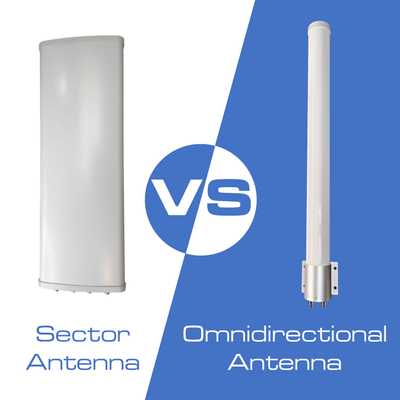
Choosing the Right Antenna: Sector vs. OmniDirectional
Posted by Gordon Reed on 24th Feb 2026
When designing a wireless network, the most important decision is not brand, enclosure style, or even gain. It is radiation pattern.
Sector and omnidirectional antennas both provide area coverage, but they distribute RF energy in fundamentally different ways. Understanding that difference directly impacts SINR, interference rejection, throughput, and overall network efficiency.
This article breaks down the technical differences and when each antenna type makes sense.
What Is an Omni-Directional Antenna?:
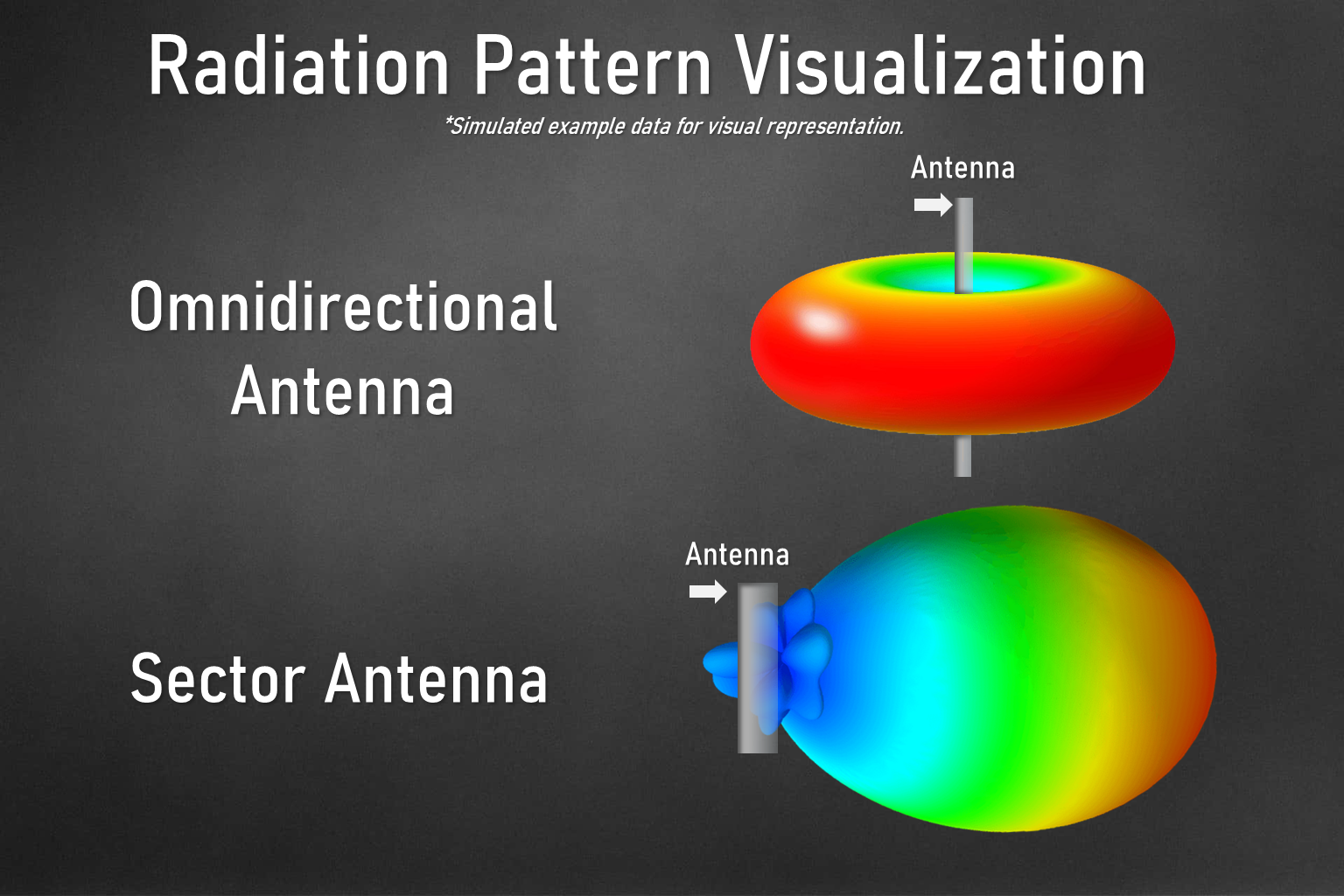
An omnidirectional antenna radiates energy in a full 360-degree horizontal pattern. From a top-down perspective, the coverage appears circular. In three dimensions, the radiation pattern resembles a doughnut.
Radiation Behavior
- 360° azimuth coverage
- Vertically compressed pattern as gain increases
- Energy evenly distributed around the antenna
As gain increases, the vertical beamwidth narrows. The antenna does not push signal farther in all directions equally, it compresses the elevation lobe and flattens the pattern.
Electrical Characteristics
- Common gain range: 2 dBi to 9 dBi
- Typically vertically polarized
- Low front-to-back ratio
- Minimal directional discrimination
Because the antenna “hears” and transmits in all directions, it also receives noise from all directions. In low-interference environments, this is not a concern. In congested RF environments, it can reduce usable SINR.
Ideal Use Cases
- Central router installations
- Small offices and homes
- LTE failover routers
- Low client density areas
- Temporary or mobile deployments
Omni antennas prioritize simplicity and equal-area coverage.
What Is a Sector Antenna?:
A sector antenna is directional, but instead of a narrow beam like a Yagi or panel, it covers a defined horizontal arc. Common sector widths include 60°, 90°, and 120°.
Radiation Behavior
- Defined horizontal beamwidth
- Controlled vertical beamwidth
- High front-to-back ratio
- Focused energy within the sector
Instead of spreading RF energy across 360 degrees, a sector concentrates it into a specific coverage zone. This increases usable signal strength inside that zone while reducing off-axis interference.
Electrical Characteristics
- Higher gain than most omni antennas
- Improved interference rejection
- Better SINR in structured deployments
- Frequently used in MIMO configurations
Because the energy is concentrated, sector antennas typically provide greater effective coverage distance within their intended arc.
Ideal Use Cases
- Point-to-multipoint WiFi systems
- Industrial yards and campuses
- Marinas and agricultural sites
- Fixed wireless access
- Structured outdoor LTE deployments
Sector antennas are commonly deployed in groups to create segmented coverage around a tower or structure.
Radiation Pattern Comparison:
Azimuth Plane
From a top-down view:
- Omni antennas provide full circular coverage.
- Sector antennas provide a defined arc.
An omni distributes power equally. A sector concentrates it.
Elevation Plane
Both antenna types compress vertically as gain increases. However, sector antennas often allow more control of vertical shaping, which can be important in tower deployments where downtilt is critical.
Gain, Beamwidth, and Coverage Tradeoffs:
Gain and beamwidth are inversely related.
Higher gain results in a narrower beam. This applies to both omni and sector antennas.
An 8 dBi omni will have a narrower vertical beam than a 3 dBi omni. A 14 dBi sector will have a tighter coverage arc than a 9 dBi sector.
The key difference is energy distribution:
- Omni antennas distribute energy evenly.
- Sector antennas redistribute energy into a controlled region.
This redistribution increases effective radiated energy within the sector without increasing transmitter power.
Interference and Network Performance:
Noise Floor
Omni antennas receive noise from all directions. Sector antennas limit reception to a defined coverage area.
In high-density RF environments, limiting the receive aperture improves overall network stability.
SINR and Throughput
Better directional control improves SINR, which directly improves modulation schemes, data rates, and link reliability.
Sector antennas often outperform omni antennas in multi-client outdoor deployments because they reduce co-channel interference.
Frequency Reuse
In structured wireless networks, sectorization allows frequency reuse across different arcs, increasing total network capacity.
When to Choose Each Type:
Choose Omni If:
- You need uniform 360-degree coverage
- Client density is low
- Deployment is small-scale
- Interference is minimal
- Simplicity is preferred
Choose Sector If:
- Coverage must be segmented
- Higher gain is required
- Interference mitigation is important
- You are deploying a point-to-multipoint network
- Throughput consistency matters
Common Misconceptions:
Higher gain does not mean more distance in every direction.
An omni antenna does not become directional just because the gain increases.
Sector antennas are not automatically better. They are more efficient only when coverage control is required.
Performance always depends on mounting height, down tilt, cable loss, frequency band, environmental noise, and system design.
Real-World Deployment Considerations:
- Mounting height changes coverage geometry
- Electrical or mechanical downtilt affects the usable footprint
- Polarization alignment must match client devices
- MIMO spacing affects spatial diversity
- Coaxial cable loss reduces effective gain
- Outdoor installations require proper environmental protection
The antenna pattern must match the deployment layout. Otherwise, signal is wasted where it is not needed.
What This Means for You:
Choosing between sector and omnidirectional antennas is not about which one is stronger. It is about matching radiation pattern to coverage objective.
Omni antennas provide equal-area distribution.
Sector antennas provide controlled, efficient coverage.
Selecting the correct radiation pattern improves SINR, increases usable throughput, reduces interference, and creates a more stable network.
If you are designing a deployment and need help determining which pattern best fits your layout, AntennaGear provides solutions engineered for real-world RF performance.