
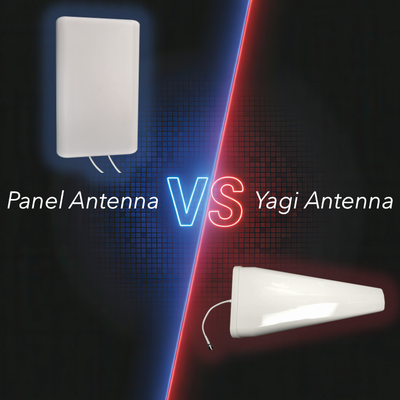
Choosing the Correct Directional Antenna, Panel or Yagi?
Posted by Gordon Reed on 18th Feb 2026
When cellular performance drops, most people immediately look at antenna gain. More dBi must mean more signal, right?
Not necessarily.
In directional deployments, especially for LTE and 5G systems, the type of directional antenna you choose often matters more than the raw gain number on a datasheet. Two of the most common directional solutions are panel antennas and Yagi antennas. Both focus RF energy in a specific direction. Both can significantly improve RSRP and SINR in the right environment. But they behave very differently in real-world deployments.
Understanding those differences can mean the difference between marginal improvement and measurable performance gains.
Why Directional Antennas Exist in the First Place:
Omnidirectional antennas radiate energy in a 360-degree horizontal pattern. That is ideal when signal arrives from multiple directions or when tower location is unknown.
Directional antennas do the opposite. They concentrate RF energy into a focused beam. By narrowing the radiation pattern, they increase forward gain and reduce energy received from unwanted directions. This improves link budget, increases signal-to-noise ratio, and can reduce interference from neighboring sectors.
Directional antennas are commonly used when:
- The serving tower is far away
- Signal is weak but consistent from a known direction
- Interference from other towers or sectors is degrading SINR
- A fixed installation allows precise aiming
Within this category, panel and Yagi antennas are two very different engineering approaches to solving the same problem.
What Is a Panel Antenna?:
A panel antenna is typically a flat, rectangular enclosure that houses an internal array of radiating elements positioned in front of a reflector. The radiating structure may be printed elements on a PCB, dipole arrays, or other engineered element geometries, depending on frequency band and polarization requirements.
From the outside, a panel antenna appears compact and low profile. Internally, it is a carefully phased array designed to shape a controlled directional pattern.
Radiation Pattern Characteristics
Panel antennas generally offer:
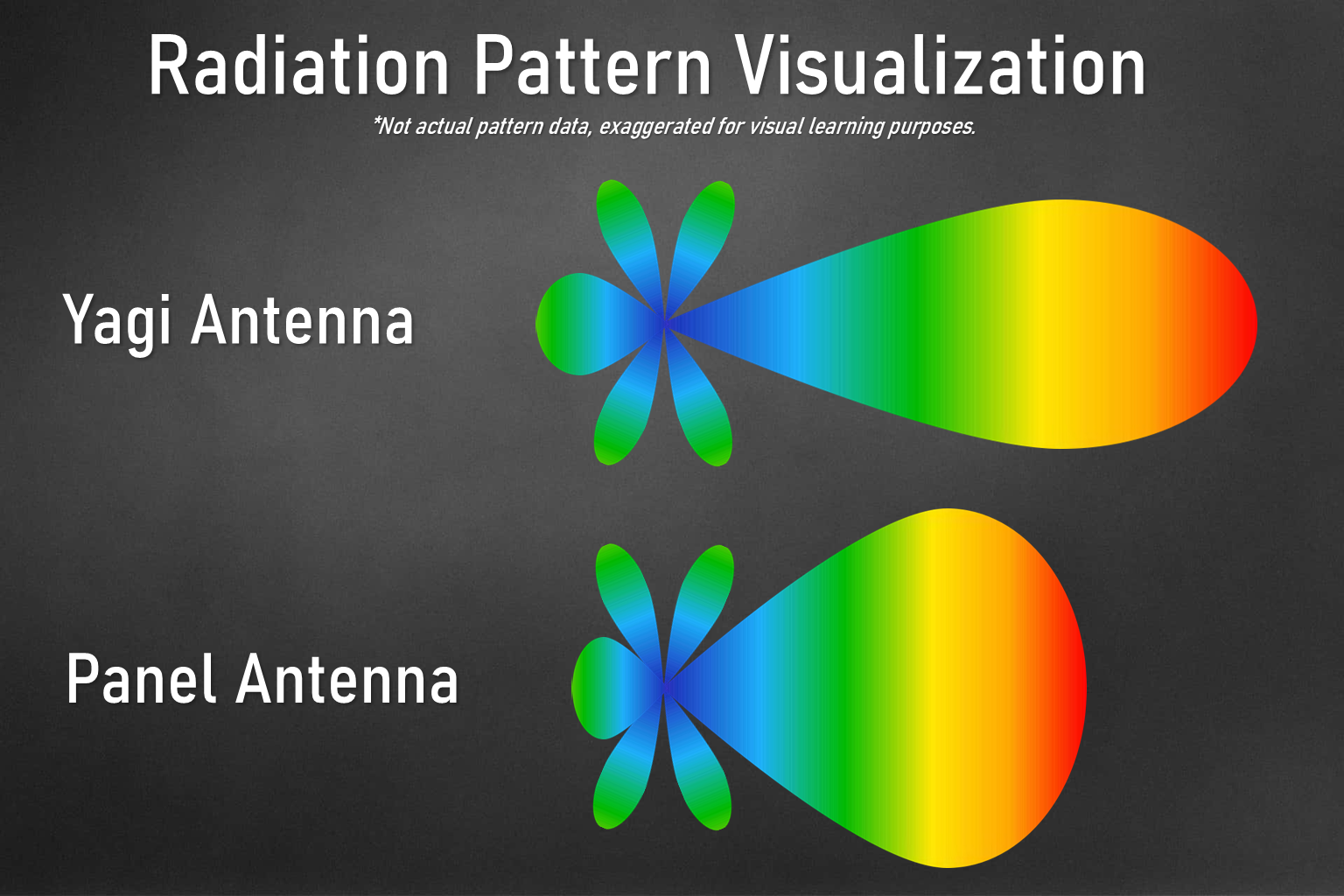
- Moderate beamwidth, often between 30 and 70 degrees horizontally
- Controlled front-to-back ratio
- Smooth main lobe with relatively low side lobes
- Balanced directional performance without extreme focusing
This wider beamwidth makes panel antennas more forgiving during installation. If alignment is slightly off, performance degradation is typically gradual rather than severe.
Gain Ranges
For cellular LTE and sub-6 GHz 5G deployments, panel antennas commonly range between approximately 6 dBi and 15 dBi, depending on frequency band and design.
As gain increases, beamwidth narrows. This is a fundamental tradeoff governed by antenna theory. Higher directivity requires energy to be concentrated into a smaller angular region.
MIMO and Polarization
Modern panel antennas are often built specifically for MIMO systems. Dual-polarized configurations, such as plus and minus 45-degree slant polarization, allow simultaneous spatial streams while maintaining proper isolation. This makes panels particularly well-suited for LTE and 5G routers that rely on 2x2 or 4x4 MIMO for throughput.
What Is a Yagi Antenna?:
A Yagi antenna, formally known as a Yagi-Uda array, consists of a driven element, a reflector, and multiple parasitic director elements mounted along a linear boom. The directors shape the radiation pattern by reinforcing energy in the forward direction and suppressing it elsewhere.
Unlike panel antennas, Yagis have an open-element structure. The boom and elements are clearly visible, and the antenna is physically longer in order to achieve higher directivity.
Radiation Pattern Characteristics
Yagi antennas typically provide:
- Narrower beamwidth than most panel antennas
- High front-to-back ratio
- Strong forward lobe
- Increased sensitivity to aiming accuracy
Because the beam is narrower, alignment becomes more critical. Small angular misalignment can result in significant drops in received power.
Gain Ranges
Depending on the number of directors and overall boom length, Yagi antennas for cellular frequencies often range from about 9 dBi up to 18 dBi.
Higher gain is achieved by increasing the number of director elements, which increases directivity and reduces beamwidth.
Beamwidth vs. Precision, Why It Matters:
Half-power beamwidth defines the angular width of the main lobe where gain drops by 3 dB from its peak. This parameter directly affects how precise installation must be.
A panel antenna with a 60-degree beamwidth allows a broad aiming window. This is useful when:
- The exact tower sector is not precisely known
- Tower density is moderate
- Slight environmental changes may affect propagation
A Yagi with a 25-degree beamwidth demands far more precision. It can excel in fringe environments where:
- The serving tower is far away
- The direction is clearly identified
- Maximum forward gain is required
The narrower beam can improve SINR by rejecting off-axis interference. However, if aimed at a congested sector, a high gain Yagi may amplify congestion rather than improve throughput.
Signal Strength vs. Signal Quality:
Antenna gain increases RSRP by concentrating energy. However, throughput depends heavily on SINR and overall link quality.
In LTE and 5G systems:
- RSRP indicates received signal strength
- SINR reflects usable signal quality relative to noise and interference
A high-gain Yagi may significantly increase RSRP, but if it also captures strong interference from that direction, SINR may not improve proportionally.
Panel antennas, with their slightly wider beam and often optimized MIMO performance, may produce more stable throughput in environments where multipath and sector overlap are factors.
This is why system-level evaluation is critical. The antenna is one component in the RF chain.
Cable Loss and System Design:
Higher-gain antennas are often installed on masts or rooftops, which can increase coaxial cable length. Every foot of coax introduces insertion loss. At cellular frequencies, especially above 2 GHz, this loss can quickly offset the theoretical gain increase of a higher dBi antenna.
A 3 dB loss in coax effectively cuts power in half. In some installations, upgrading cable quality or shortening cable length may provide as much benefit as switching antenna types.
When designing a system, always evaluate:
- Antenna gain
- Beamwidth
- Cable length and loss
- Connector integrity
- Router modem capabilities
Focusing on gain alone is rarely the optimal approach.
When to Choose a Panel Antenna:
A panel antenna is often the right solution when:
- You need directional improvement, but want installation flexibility
- Tower direction is known but not perfectly isolated
- A compact, low-profile installation is desired
- MIMO performance and polarization diversity are priorities
- The environment is moderate fringe rather than the extreme edge of coverage
Panels offer a strong balance between performance and practicality.
When to Choose a Yagi Antenna:
A Yagi antenna is often ideal when:
- You are at the edge of network coverage
- The serving tower is clearly identified and distant
- Maximum forward gain is required
- The installation is fixed and stable
- Precision aiming is feasible
In these scenarios, the narrower beam and higher directivity can meaningfully improve link budget.
Common Misconceptions:
Higher gain does not automatically mean better performance.
All directional antennas do not behave the same.
Beamwidth absolutely matters.
A Yagi does not inherently outperform a panel in every scenario.
The correct choice depends on environment, tower geometry, interference profile, and overall system design.
What This Means for You:
Panel antennas and Yagi antennas are both powerful tools in directional cellular deployments. The key difference lies in beamwidth, precision, and how they interact with your specific RF environment.
If you need a forgiving, MIMO-ready solution with controlled directionality, a panel antenna may be the better fit. If you are reaching across long distances in a fringe environment and can precisely aim the antenna, a Yagi may deliver stronger forward gain.
Before selecting hardware, evaluate your RSRP, SINR, tower direction, cable length, and mounting constraints. Directional antennas are not universal upgrades. They are engineered solutions for specific propagation challenges.
For product-specific options and additional technical guidance, visit AntennaGear.net to explore directional antenna solutions built for real-world LTE and 5G deployments.